Pages

11.27.2012

Kindergarten - 3D lines

So, in the beginning of the year kinders and I spend A LOT of time on lines and shapes.  I do this because it helps the students learn routines and expectations without overwhelming me or them with complex projects.  Simple but meaty projects like these also show me simple things like - problem solving skills, skills they already have, ability to follow directions, fine motor skills - etc.  I learn a lot in the beginning of the year about where my kinders are at developmentally.


After a few projects that consist mostly of different flat lines and shapes - I take the kids 3D.  We briefly talk about what 3-D and 2-D means, some kids get it, some don't.I show students a variety of ways to make a flap stip of paper stick up in space.  We bend, we fold, we twirl around our fingers, we add pieces to other pieces and build build build!  I also stress as much as I can that glue sticks when it DRIES - if you use A LOT of glue then it takes a LONG time to DRY - a little bit of glue - stick faster!  The students get really excited by the time I am done with my demonstration.

I turn the kiddos loose and tell them they have to build till it is time to clean up!!!  I walk around help students that struggle with concepts they want to try, offer positive feedback to students.  After about half way through class I will walk around with my iPad and record students that struggle with building 3D and using an appropriate amount of glue.

I like to let these rest/dry for a few hours and hang in the hall.

They are impressive when all posted together on a board!


2nd Grade - Mock Batik

This is the project I did at the very beginning of the school year, with second grade.  As I have posted before I like to do name projects as our first projects, because it refreshes my memory and they can all write their own names - thus everyone succeeds!! Hooray!

First day we practice bubble letters - both normal bubble letters then FUNKY bubble letters.  Funky bubble letters are the same as normal bubble letters, only you use fun lines like zig-zag, castle top, curly, etc.

The next class students got a final paper in which they wrote their name - normal, funky, or a combination.  Then they traced their name with a black oil pastel and added 5 lines that started on one edge and went off a different edge.  (A few students needed to add a few more lines to break up the space).

Next, I explained what a batik was (I tried to find a good video, but found nothing - if you have one let me know!).  I told them that other countries mainly used batik to decorate fabric.  The artist/worker would take hot wax and draw pictures onto a piece of fabric, then dye the fabric a color -- wherever there was the wax no dye would stain.  This process would continue till everything was dyed as desired.  In the end the wax was washed off with hot water and a beautiful piece of fabric was ready to be used.  I showed students some batik cloth.

I explained that we wouldn't be adding hot wax to fabric, but instead we would use colored wax to color our pictures.  I asked students if they knew what crayons were made out of - WAX!  I instructed them to color their pictures by pressing SUPER HARD and coloring each section a different color.  (They could repeat colors, just not next to each other.)

After their WHOLE pictured was colored, and I was pretty picky about having very little white space.  I had students crumple their papers into really SMALL balls 3 times - flattening it out each time.

Next, students took their wrinkled, but flattened paper to the sink where there was a cup with watered down temp paint (I did some classes with black - some with blue).  Students painted over their whole papers with the paint - then rinsed off the paint with a gentle stream of water.

What was left was nothing short of magic - their papers had beautiful colored wax, and the paint stuck to all the creases they made when they crumpled it.

Students oooo-ed and ahhhh-ed and showed their friends!

 I even had a student bring in a batik stamp from a trip they went on!


11.05.2012

5th Grade Production is a PRODUCTION

Wow - where to start?  I didn't mean to take a break from this blog - it just kind of happened.  October was full of teaching my normal classes, 5th Grade production (it is a production in every sense of the word), collecting and organizing 5th grade production T-shirts (this included a crash course in Adobe Illustrator), finalizing and organizing a Spirit Wear order for the school, contacted a really awesome artist for a future visit, class collaboration art masterpieces for a district auction, grades, and I tried to squeeze in another fundraiser - Young Masters - this ended up having to be postponed...

So, I guess what I am trying to say - is that it has been, well, a bit busy!

Wool Pirate Hair
Let's start with 5th Grade Production.  I love 5th grade production in every single sense of the whole event - well maybe not the extra talking from students during rehearsals or loosing prep time on Tuesdays - okay... so I love mostly everything about production.  Production is hard to describe in words - production is a PRODUCTION.  Organizing 4 teacher visions for a show, with 84 5th graders --- it couldn't be anything less than a production.

Pirate Costume Party
I really enjoy that the students have a voice in our show, they share ideas and we try to incorporate as much of it as we can.  I had four students arrange one of their songs into a rap - we recorded it (thanks iPad).  I think it is super special that the students apply/try out for what they want to do: actor, musician, dancer, set design/chorus.  We are lucky to have a drama and dance teacher at this Elementary school - and they rock.

So, normally production starts in 4th grade with a gathering of ideas and characters.  Then the ARTs (dance, music, drama and myself) and 5th grade teachers mull over the student ideas to try and make a story/plot.  Last year our drama teacher wrote the script - it was AMAZING.  This year there was not time - so we bought a script based on the interest of our students.

Luckily the script stated we could alter the story, add songs, take things out - it was perfect.  We added some songs, took out others, let the musicians re-create some.  Students drew out ideas for backdrops in my room -- I took ideas from multiple papers to create the 3 backdrops for this show, which the students mostly painted.  Dancers created original movements and dances for songs.  Musicians composed original songs and sound effects for the show.  Actors memorized lines and blocking!


Our show this year was Treasure Island - so most of the kids would need some kind of pirate outfit.  I wasn't sure how to get kids to make a pirate-ish shirt, how to collect objects, how to deal them out.... Then, our Dance teacher had a brilliant idea - a costume party.  So, one day instead of having normal 'specials' during our 5th grade time - students went into a creative, surprisingly controlled costume making frenzy.  Students added paint, sparkle glue, buttons, leaves - they cut, sewed, and added bits and pieces to make their costumes all their own.  My favorite part was this awesome wool I happened upon on a donation to the high school - it looked just like dreads.  I cut and glued chunks together for 'pirate hair' - it was wickedly cool.

For the next 8 weeks, once a week for about 30 minutes students split up into their assigned jobs and we created a show.  We had 3 after school rehearsals to mesh all the acting, dancing, musicians and such together.  Then we had a full day TECH rehearsal so my kids could learn when to change the set, spots knew who to follow - what lines were sound cues for music.

Front of their T-shirt - 100% kid designed
Now, while production was happening on Tuesday mornings - during normal 5th grade art time students became Graphic Designers and designed their Production T-shirt.  In the end, the students voted it down to 3.  I combined those 3 ideas because the votes were so close.

It is a SHORT LONG 8 weeks.  In many ways the 8 weeks drags on, but then it never feels like enough time.

Somehow, no matter how far behind we feel, or how crunched for time - it all pulls together for an amazing show.

I am SUPER proud of my 5th graders for all their hard work.

9.30.2012

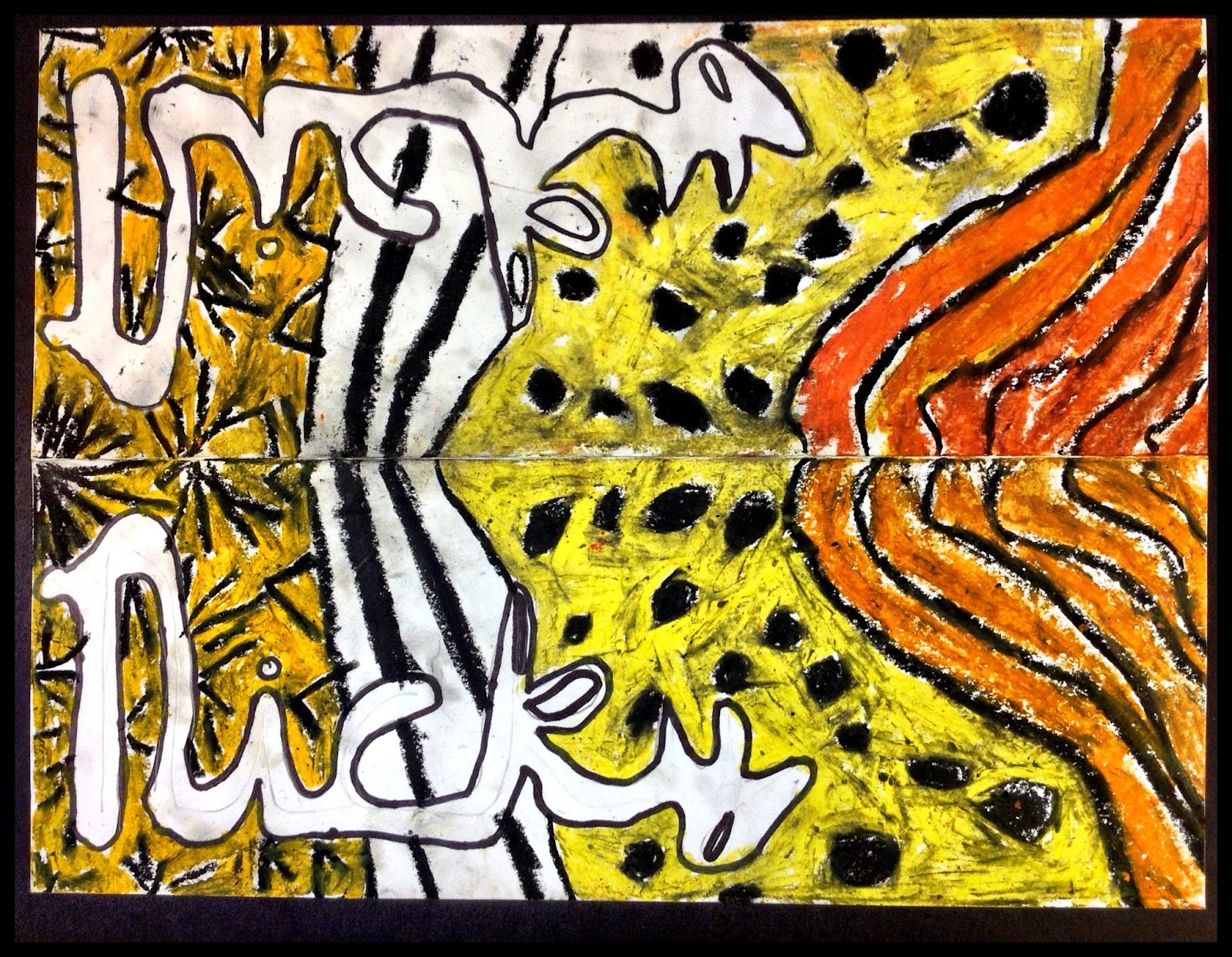
3rd Grade Reflection Names


This project has gone through a few changes - I started it a couple of years ago and was never really happy with how it turned out, until now.

Most years I have the kids decorate their letters instead of the background - but their letters often ended up narrow and small leaving LARGE open, untouched, white spaces.  This year I opted to have them leave their letters white - AMAZING difference.

Here is how we did them.
1) Fold 9 x 12 paper in half hot dog style.
2) Leave folded and draw name in BIG bubble letters -- normal or funky (using different kinds of lines)
3) Sharpie trace name.
4) Go to window/light table and place NAME on surface so the blank side is facing you.
5) Trace name through paper using a pencil - name will be backwards - it's okay, it should be. (this is the hardest part for students to do - it is hard for them to do it backwards)
6) Sharpie backwards name.  (you could skip the pencil on the backwards name, but 3rd graders tend to sneeze or bump each other and want to start over.)
7) Pick ONE side of paper and use a black oil pastel to draw SIMPLE designs.
8) Fold paper backwards so that the names touch each other.
9) RUB paper while folded - rub hard.
10) Open.  The oil pastel will transfer lightly to the other side - trace these marks with black oil pastel.
11) Time to color.  I tell the student to turn their paper vertical/portrait style.  It tricks their brain into see the patterns they drew instead of their names.  Then I tell them to start at the fold and work their way out.  Whatever they do to one side of the fold needs to be done to the other side.
12) Continue till finished!

These took use about 3 50 minutes classes.  We talked a lot about reflections -what they are, where we see them, how they work - why when we look in the mirror the words on our shirt look backwards - etc.

The kids had to trust the instructions on this proceses, as many of them couldn't visualize where it was headed.  When it was done or close to be done they were mesmerized and thrilled at the results (I was too).


This project is great at the beginning of the year because it helps me to re-learn names, see how they have grown over the summer, and how our year will go.


9.29.2012

Organized Chaos has joined Facebook!

I have been trying to figure out different ways to share more student work with all of you and my parents.  I tried a website - too much to keep up.  I thought about a Facebook page for my classroom - but having two classrooms to do and keep up on - too time consuming.

Alas, I decided I would just take my blog to Facebook.  I will post when there are new entries on the blog, LOTS of student work, and other tidbits I find interesting in the art world.

Come check out Organized Chaos on Facebook and 'Like' it if you want to see updates in your newsfeed.

https://www.facebook.com/msnovakorganizedchaos

See you there.

9.21.2012

Not Enough

I absolutely love my job.  I feel blessed and excited to come to 'work' each day.  I try and do my best each and everyday to reach out to my students, to provide them with opportunity to grow, take chances, problem solve, deal with frustration, and ask for help.  Most days I go home feeling like my day was worth something, that I made some kind of small difference.......

But then there are some days that I don't feel I'm doing enough - that my classroom is not as engaging as it should be, that I am not the teacher I should be.  Am I doing all I should for my students?  What could I do differently to pack as much as I can into 50 minutes of class once a week?  How much am I helping my school environment help keep the focus directly on the students and not on the multiple standardized tests the district/nation likes to call "assessment". 

I sit and wonder and wish for all the classes I could take to challenge my thinking - or the conferences I could go to for inspiration and new skills -- and then I look at the cost.  I really hate the fact that I haven't taken any graduate classes or gone to any type of conference and my only excuse is that I can't afford it.  I am putting less money in my pocket today than when I started teaching 4 years ago - granted my income says I am making more, but less is making it to me.  bah!  I digress - money is not the real focus of this post.

I hunger to be a better teacher, to embrace the exuberance of my students - to move them in such ways that they think more in depth and make choices with purpose.  I want to be the teacher that my high school Humanities teacher was to me.  He was passionate, he questioned us, he asked us to think instead of being told what to think.

I want to be more than 'just' an art teacher to my students.  I want to be someone that opened their eyes to a world they didn't see before.  I want to give them enough courage to take chances and ask questions.

Perhaps I am doing some of these things - on a smaller scale maybe.  I have such high hopes and dreams for my students - for my art program.  I know my room makes a difference for students, but I want art (and music) to be more than a "special" - to be valued more than a prep time for grade level teachers.

What I really want is to reform education in a way that is drastic and beautiful.  I want to change the whole way our nation thinks about education.  I want kids to love school.  I want teachers that have teaching in their blood - that are crazy passionate about not only their students, but teaching them.  I want an education system that celebrates the diversity of our students and our teachers - instead of punishing/rewarding on standardized tests.  I want an education system that rewards innovation and creativity - and terminates teachers that do the bare minimum.

I dream of a time when people who are making choices about education actually listen to the teachers -- not to the union reps or to the teachers who yell the loudest -- but to teachers, the humble, the eager, the devoted.  I dream of a time when we fixed education by looking where we want to go instead of trying to fix a broken system.

I say and dream all these things - I know what I want it to look like in the end, but I currently have no idea how to get there.  I can see the future, and it looks so bright -- yet I have no idea how to get there, let alone how to convince other people it will work.

I feel the need to stretch my teaching, to be more than who I am now.  Perhaps some books, save some money for some interesting classes....... dive more into my dream of education and figure out a path.

9.12.2012

Chicago Teacher Strike - a different perspective

I got this from a friend in Chicago Public Schools and it sheds a very different light than what the National News is portraying.

I didn't post this to create any hostility or debates - but rather as a way to see it from another perspective - from the teacher perspective.  It doesn't matter what side you stand on - but it is important to listen and understand the other side.


"They are saying all sorts of things on the national news, but there is a lot of misinformation and confusion. We are not striking over pay and we aren't demanding 19%. That figure comes from the independent arbitrators report that was released in June. Our mayor has extended our school day and year by 11%. The arbitrator said we should be compensated for our time. Last year, the final year of our previous contract, Rham said the school system couldn't afford the 4% raise that was in our contract so we didn't get anything. That money was then used to hire consultants making six figures, pay bribes/bonuses to schools and principals that didn't follow the contract, and some was transferred to the police department. The arbitrator said we should get that 4%. Finally, he recommended a 1% COLA raise for 4 years. That is where the 19% figure came from as far as I know.

The main issues for teachers are evaluations and teacher recall. I'll try to be brief on both, they are implicated issues. The board is proposing an evaluation system where 40% of our ratings will be based on test scores. For non classroom teachers part of this is a subject specific test and part is school wide literacy scores. I was on the team that designed the music assessments and after we finished them they were changed significantly. A listening exam about instrument families was changed to examples of individual instruments for example. As for the literacy scores, if the entire building doesn't go up, our ratings are lowered. My school is at 93% meets and exceeds with 18% special needs students. If our scores don't go up, we are considered unsatisfactory and subject to being fired. For classroom observation, the other portion of the proposed evaluation system they are using a distorted form of Charlotte Danielson's work. She has said it is not ment o be used this way, but they don't care. We have already been told hardly anyone will qualify for the top category, you have to be a perfect teacher in all four dementions. They did want to tie this to merit pay, but have dropped that as they couldn't formulate a plan as to how it would be implemented.

Another issue in CPS is that they are using testing scores to put schools into turnaround. This means they fire the staff and give the school to a charter company. The charters do not have to hire all certified teachers, and they can turn away students with disabilities and behavior problems. Veteran teachers, some NBCT's are displaced and have trouble finding new jobs due to the stigma of turnaround. Principals are hiring first year and TFA teachers because they are cheaper. Some schools have huge teacher turnover each year, but they won't hire experienced educators who want to stay in the system. We are asking for a recall process where principals would have to interview veteran teachers for positions, but principals would still have final choice over who they hire.

There are other issues that we can't strike over: class size, most are 30-45, building conditions, air conditioning, materials, we often don't have them, sick day accumulation, a punitive wellness policy and much more. We want better schools for our students and teachers, not education on the cheap. Outside groups are putting a lot of money towards "school choice", but none of that money makes it to the schools. None of the board members or high ranking people from downtown are educators, most haven't been into a CPS school for anything but a press conference or photo op. They have no idea what our schools are dealing with and blaming teachers is the party line. That's why we are striking and will continue until we have a fair contract.

Over 140 CPS schools don't have libraries. My request for screens on my second floor classroom windows was denied. 101* in my classroom on the first day of school. Today we moved our rally from downtown to three schools in the poorest areas of the city. As we marched through the neighborhood past the hosing projects and boarded up buildings the kids swarmed out to join us. There was 100% support from the parents, ministers and businesses. I know they are saying horrible things about us in the national media, but we are receiving a lot of support from our communities."

9.07.2012

Ahhh. Almost time

I really have enjoyed seeing different art rooms across the country get ready for a year of organized chaos - rooms that are organized and ready for paint spills, lost marker caps, pencil shavings, and broken crayons.

I took a few pictures last week to show how I prepare for a year of 500ish students in 3 days time at one of the buildings I teach at.  
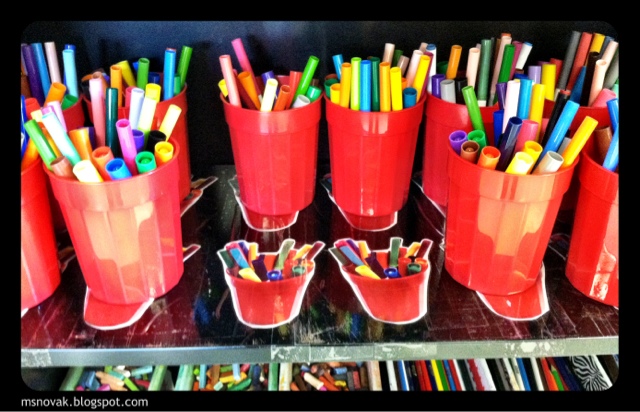
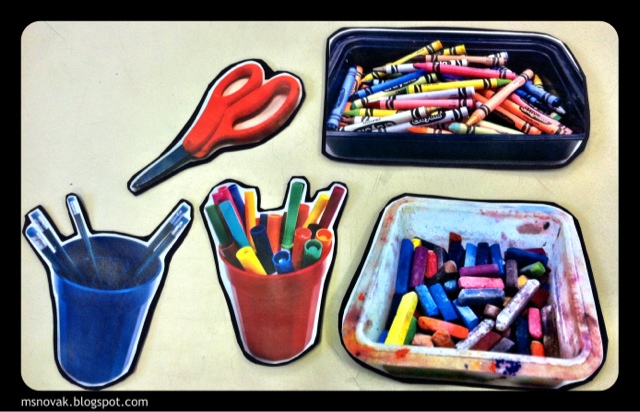
I got new marker cups - so I took new pictures and taped them down where they go!  Makes clean up easier for me and students!
I take the pictures I tape down - print out one extra, laminate, stick a magnet on the back and use on the whiteboard to help show instructions.
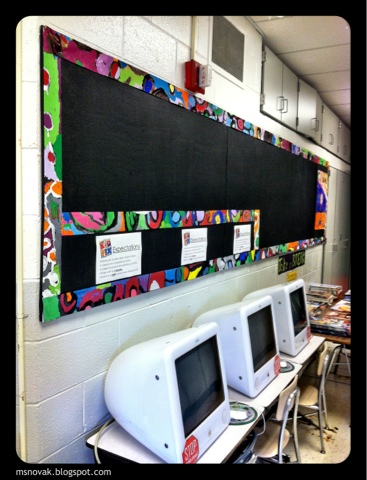
My computer station for when kiddos are finished!  The STOP signs remind them to check and see if their hands are clean!


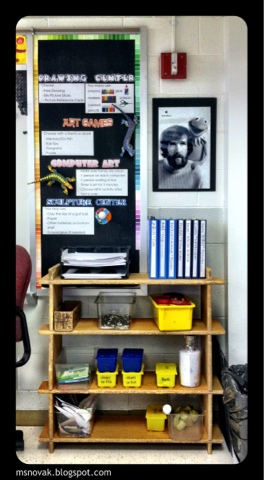
Here is my done, or rather - "Finished" area.  Students may pick from:
  • Drawing Center (Free draw, silly picture sticks, picture reference cards)
  • Art Games (Art Memory/Go Fish, Puzzles, Eye Spy, Tangrams/Tangoes
  • Computer Art (KidPix)
  • Sculpture Center (Modeling Clay, surprise scrap bucket - string, paper, wire... )
  • Ask for a job (cleaning paint brushes, returning books to library, organizing papers, taking projects off of bulletin boards... etc) 

Okay - whoever came up with this BRILLIANT idea for a yarn center - you are my HERO!  I don't remember if I saw this on Pinterest or a blog first - but seriously genius!!!  I first tried to drill the holes in the plastic - bad idea, it cracked.  I then got smart and heated up a high heat glue gun.  Duh - melt the holes!  I got these bins for 1.00 each at a dollar tree near my school.  I have put two cones of yarn in each one -- I don't know if they are going to tangle as they get used, but it has to be easier to deal with than normal string tangle messes!


And last, but not least, my new Art Rubric!  I made this to help remind me to be more clear with students about how they are doing in art.  I made this based on how our report cards are, so that parents and students can easily see and understand how art is 'graded'.  I don't grade based on if I like it or not or even give everyone a perfect score.  There are lessons to be learned in art while still being creative.

1=Met all project expectations and student had wonderful craftsmanship.  2=Met most of the expectations and their craftsmanship is okay, but could use a little work.  3=Missed most or all expectations and little to no effort was put into the crafting of the project.

I used words and pictures to help showcase what each level looks like.  The trick in art is that there are so many options that it is sometimes hard to decide one or a two.  For example a student may meet ALL the expectations but has only so-so craftsmanship --  I have even had students that have great craftsmanship, but don't always follow directions.... or then there are the kids that work super hard so they NEVER finish a single project.  It is difficult and sometimes frustrating to 'grade' art -- but this system seems to give me enough wiggle room to really let the kids make creative choices about their projects.  I could make it more specific - but I feel that limits the students choices and really doesn't teach them what I want them to learn.

8.27.2012

ARTkive

Okay - so quick and informal post. I just found an awesome app. It is called Artkive (like archive... Only with Art).

So I haven't actually used the app - but the reviews are decent. Basically the idea is to photograph all your child's work (artkiving) which you then can share, print on different products or even make a coffee table book!!!

I think the idea is genius!! If is currently FREE in the apple app store (as of the posting of this entry).

Check it out!
http://www.artkiveapp.com/

8.08.2012

Summer In The City - Detroit

Even though, last summer, I was overwhelmed and stressed about finding a job, I felt a pull to do something in the community. I dreamed of finding a place that I could donate my time, make a difference, but still take vacation without issue, and to do this all during the week.  I wanted to have my cake and eat it too. 

Needless to say I didn't search for anything along those lines my first summer in Detroit - blame it on being lazy, stressed, or convinced there was nothing of the sort.

Fast forward a year. My second summer in Detroit and that nagging feeling returns - perhaps out of boredom, perhaps out of a need to be more... more.... more than just me?

In any case, I was surfing Detroit websites and somehow ( I can't seem to recreate how I got there) stumbled upon Summer In The City. It was everything I was looking for: volunteering during the weekdays, painting, planting, playing, and only a day to day commitment.

I immediately registered to be a volunteer. I realized as I was filling out the online registration that clearly this organization is geared at people younger than I (mostly high school). I like youth and figured why not- the website said they had volunteers as young as 40.

My first few days were..... different. Not bad, but different. Somehow I thought that it was going to be like a Disney movie. I was going to go the first day and be moved to tears about all the good I was doing. I think, without knowing it, I was expecting some kind of music montage.... None of this happened. Instead I was someone who showed up amongst many, many high schoolers. I did not volunteer with anyone I knew- so, me being the shy person I am at first, I only had a few introductions to main crew people and did as I was told.

Even though my first few days were a little lack-luster - I kept going. I don't know if this was out of boredom, or if I knew somewhere inside that I needed to be there - for me. (It also had to do with Ben and Liz - who pretty much called or texted me the first few days telling me where to go and introducing me to people.)

Fast forward, again, to this evening:
It has been a few weeks of volunteering at multiple paint sites around Detroit and I finally get it. I finally get why I kept going back, why I am growing to love Summer In The City.

Before Summer In The City
Currently, it is not for the friends (as I am still getting to know people and I am still pretty quiet)- it isn't for the amazing bright paint we use (which is pretty cheerful). I keep going back because I am learning about Detroit.

I am learning about a truer side of Detroit, a side the news doesn't show, a side the burned out buildings can't show. I am learning about a side of Detroit that only people willing to feel can understand.

During/After Summer In the City
I started Summer In The City very cautious of where I was going - afraid of the neighborhoods. I actually remember wondering what I would do if someone showed they were mad I was painting over their tag.....

Instead of being presented with hostile neighbors, as I somehow expected - I have had nothing but positive comments and interactions.

People drive by and honk and shout things like, "great work" "keep it up" "looks awesome" "thank you" "keep up the fight"..... It goes on.

People stop by and ask how to get involved or who we are. More than once in the last few weeks people have made on the spot cash donations, brought water or snacks.

I am learning about a side of Detroit that is hard to explain with words. The people in the neighborhoods are passionate about the city and want it to be beautiful and safe - these people are strongly passionate, but in a completely different way than I expected.

I keep returning to Summer In The City because it is bigger than me, it is bigger than the paint- it is a small step in helping people reclaim their city. The bright murals help people smile, which helps people have hope, which then leads people to care. I keep going to get over my fear and assumptions of the city- to meet people in the neighborhoods that I am changing.

Summer In The City is becoming more than a place to spend my extra summer time - it will be a place I will return to each summer for years to come.

Thank you Summer In The City for being awesome and welcoming me so earnestly and freely.

6.11.2012

Light Graffiti (Week Two) -- Whole School

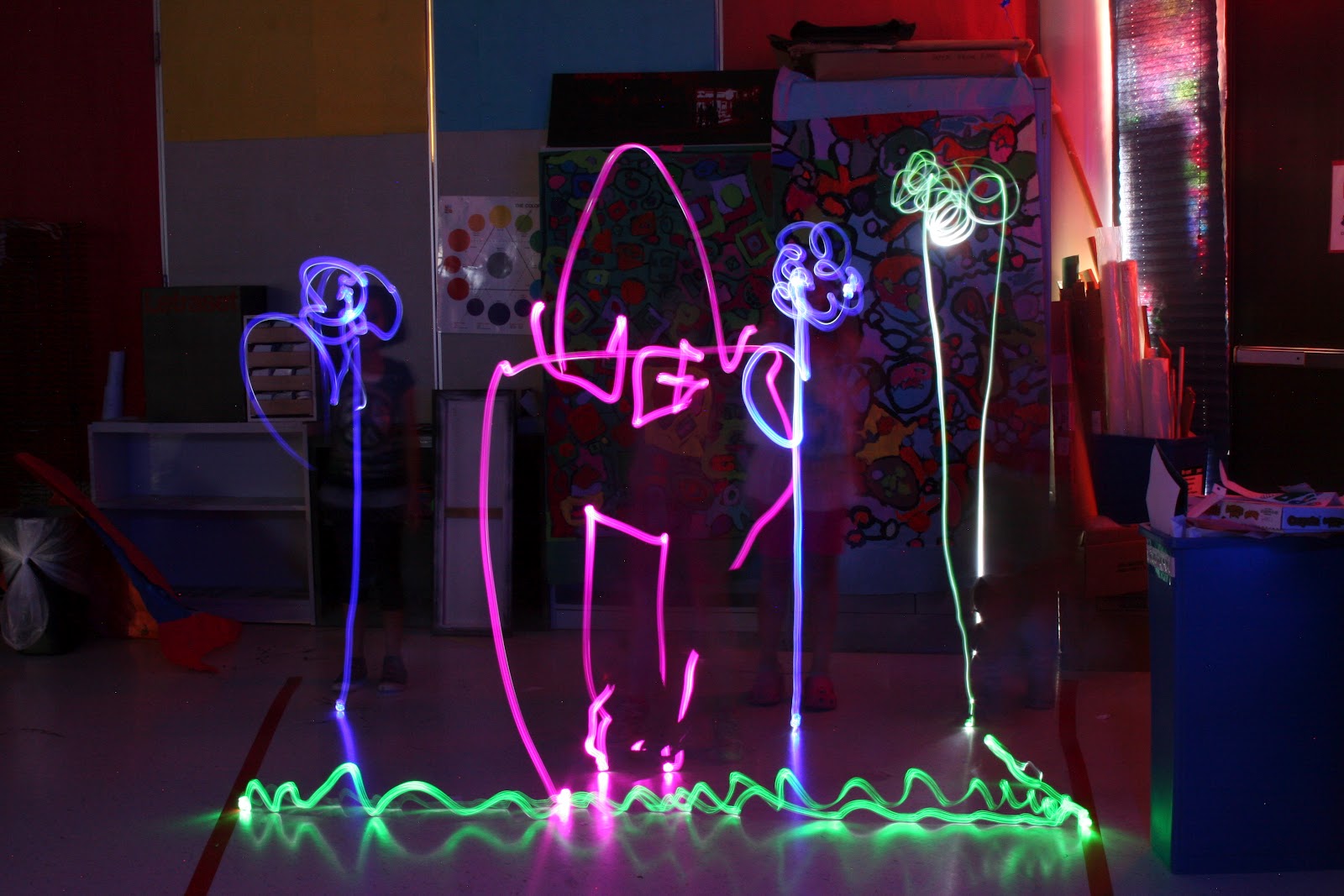
So, the second week of light graffiti is a less experimental and more deliberate.  Our goal the second week is to create recognizable pictures.  Students work in groups to create simple compositions based on a slip of paper they pull from a bucket -- it is harder than it seems.

So I do an example with a few volunteers from the class so that kids understand how it works.  I first ask my volunteers to each pull a strip of paper from a bucket.  In the bucket there are strips with words and a simple picture: grass, house, flower, tree, cloud, sun, and stars.  When we each have a strip of paper telling us what we are going to draw - we combine our images onto a piece of paper to make a picture.  I let each person draw their element on the paper and point out that no one is being bossy and telling people where to put each piece.


1st Try

2nd Try
Next  I show where to hand in the paper and return the slips.  Then I call my group to get their flashlights and get ready.

I help set up our picture by asking the class to help us figure out where to stand.  I ask them "Where should the grass be - front, back or middle?" - Most of the time they all agree with the front, but some classes need a little help figuring it out.  "Should the grass be drawn up in the air by my belly button?"  - No. "Where should the grass be?" -- On the floor.  "Okay, so now where should the flower go?" - Behind the grass.  "Where should the flower grow from?" - The grass/floor".  This process goes on till all our elements are in place.  Next, we take the picture.  When the picture is displayed on the projector we take a look and make adjustments to where we are standing, how fast we need to draw, covering our light when we are done, or perhaps getting a new light.  We then do a 2nd picture to try and improve.  Often times the 2nd picture is WAY better - though not always.  Below is a video of students doing their 2nd picture.


Next, the students break up into groups of about 5, pull their strips, draw their picture, hand in their picture and wait for their turn.  We go through the groups one at a time - making sure each group gets at least 2 pictures from the camera.

Most groups did a great job and exclaimed how much harder it was than they thought it would be.  


6.06.2012

Light Graffiti -- 2012 (week one)

As always, light graffiti has been a HUGE hit with my students the last two weeks.


The first week I introduce Light Graffiti by asking the kids what they know about 'graffiti'.  Generally someone says that it is done with spray paint and that it is illegal.  I tell them that is true, but graffiti can be more than spray paint.  I explain that graffiti is making a permanent mark on a surface that you don't have permission to write on  - and yes it is illegal.  We briefly discuss that some art might look like graffiti but are really murals.  I explain that graffiti can be a mural when the artist is granted permission to do their art on a specific surface.


After discussing graffiti and murals I ask students why they think that LIGHT graffiti might be a popular alternative in the art community.  Some classes get it right away and other classes need a little push.  I will often emphasize the word LIGHT in my sentence again.  How do you think LIGHT graffiti would differ from normal graffiti and why might artists like the alternative?!  ::POP:: ::DING:: the hands shoot up all over the room.  Yes, yes, light won't make any permanent marks on the surface - so it isn't illegal!! 


Next we watch the following two videos that I found on youtube.  I explain that the first one is a commercial and that we will watch it twice -- once for fun and the second time to look for the people creating the light graffiti.  The second video is a tutorial that explains what we need to make our own light graffiti.

1st Video:

2nd Video:


After the videos the students tell me what we need for the day:  colored lights, camera, tripod, and setting settings.  (If there is time at the end of class I explain and show the students the shutter/shutter speed).


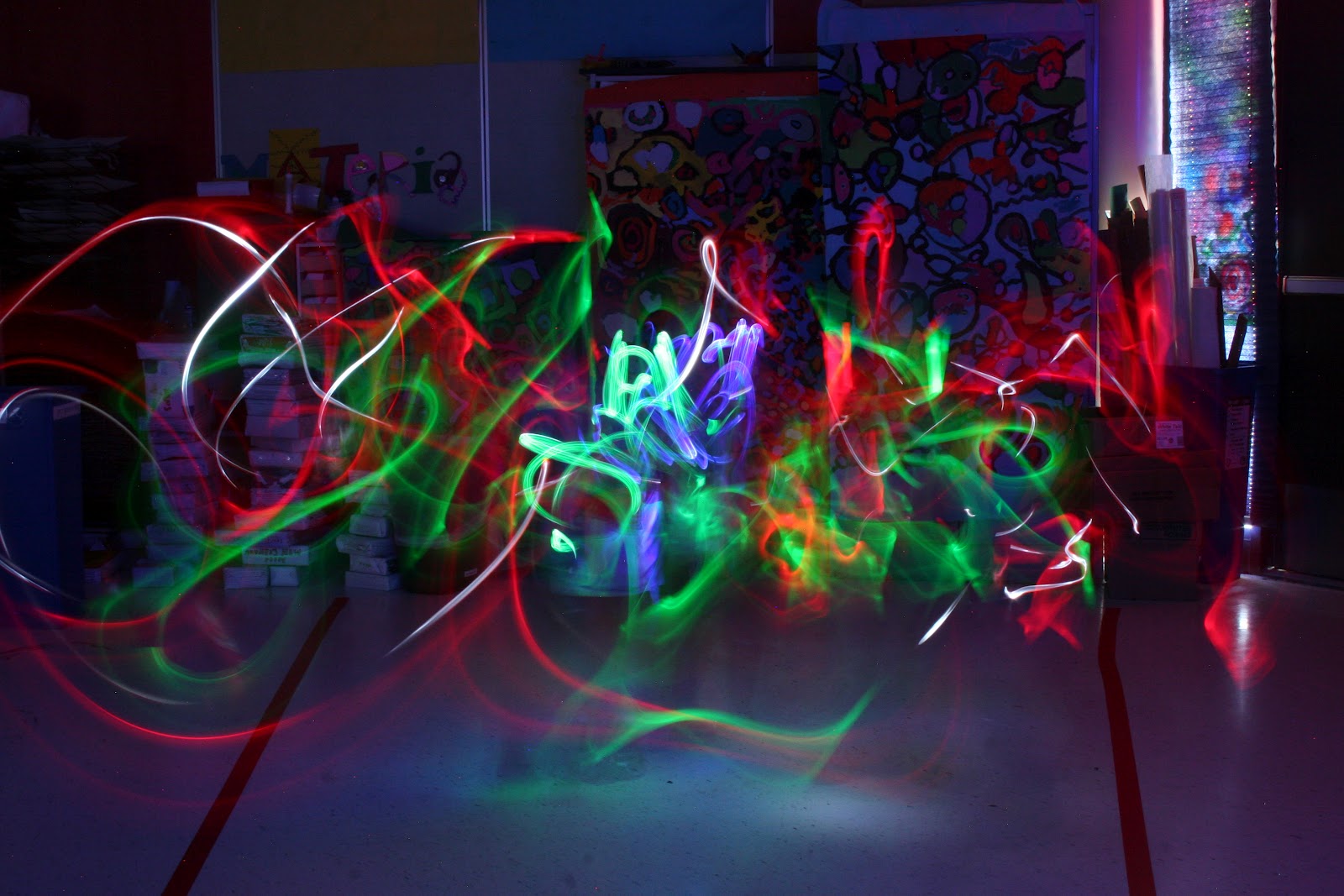
Next, I explain that I will call up two students at a time to pick out one or two colored flashlights.  When they are ready they will step inside of the polygon I taped on the floor (yes we really do talk about what a polygon is).  Then I will say "Ready, Set, Go" when I say go they can start moving around for their picture.  When their picture is over I will say something like, "Let's check it out" or "Lets see what it looks like".  The picture is then projected through our projector on the board!  I go on to explain that they will get another turn right away so stay where they are.  I want the students to go twice in a row because they learn SO MUCH from that first picture, that I want to give them a chance to try it again once they get the hang of it.  At this point I break and ask if there are questions - there are generally very few.


Then last, but not least, I ask the class if I have only two kids doing the light graffiti what is everyone else busy doing?!  "Watching" they all say.  I really stress that they need to ACTIVELY watch - as they will learn from each other.  It is safe to say that 99% of my students had never done this before and if they watch each other they get ideas and start to build off of other students movements.  It is really very fascinating.  

Again, I ask for questions - if none we get moving!

Here is a video of some kiddos making their first light graffiti:


Enjoy!  This is a blast at the end of the year!