Pages

Showing posts with label 4 Grade. Show all posts

10.16.2015

4th Grade: Silhouettes and Oil Pastel

I have no idea what to call this project - but it is really amazing and cool.  I got the majority of this lesson from smART Class, and then tweaked parts.  The high contrast, and visually dynamic product was perfect for my fourth graders.

The first day students and I reviewed what they know about colors - which colors mix to make others, which ones work well together, which ones make brown... etc.  Then we passed out liquid watercolors (honestly, never going back to cake watercolors), and two coffee filters per student.  Students were in charge of folding their coffee filters in half, twice, getting a paint brush and painting them.  This seems easy and perhaps 'boring' but the kiddos LOVED it.  The coffee filters absorb and bleed the colors around and into each other - something paper normally won't do.  It was fascinating.  The first class I introduced this to, I also planned to have them cut out their black paper - but only two kids got that far, so for rest of the classes we just enjoyed the painting.

Pumpkin patch and skeletons coming out of graves!
The second day I introduced what we were going to do with these filters.  (I purposefully did not tell them when they were painting, because I didn't want them to over plan).  I stressed to them that they did not have to do Fall or Halloween - but anything: a normal day, Christmas, Easter, a pretend place.  Our goal, rather, was to use shapes and size to help communicate to our audience what was happening not to do just Halloween.

Knee-high by the Fourth of July
Next, students used a tracer to trace and cut out a hole on their paper.  Next, students unfolded their dry coffee filters and picked which one to use for their project.  (I had students make two so that if they hated one they had another choice, and if they made a mistake on their coffee filter that we couldn't solve they had a back up).  They taped their coffee filters on the back of their paper, flipped it over and went to work drawing with a Sharpie in silhouette style. Some students really struggled with the idea of silhouette and others nailed it.  I think, in the future, I will try and introduce silhouette more purposefully and see if that helps.

The simple added detail of a house number.
The third week we busted out the oil pastels and grew our picture out into the black.  I encouraged students to take what they had already draw and continue that into the black space.  We did part of one on the board together - they brainstormed a bunch of ideas for me and then I did a 'think aloud' where I said everything I was thinking, including mistakes and changing my mind about things.  I reminded and encouraged students to use their knowledge about perspective - things far away appear smaller and things closer appear larger.  I also showed them how wonderfully oil pastels layer and blend.  I encouraged them to use more than one color for each part of their picture - if you have pumpkins, do more than just one color of orange.  I would show them and they would all 'ooooh'  'ahhh - that looks so real'.  I then, turned them loose.  Many remembered about perspective and applied it, some still are struggling with the idea that sidewalks should appear larger at one end.

Christmas!
On the fourth and final day students finished up and we did a whole class review/critique.  I post all finished work on the board.  I then set a timer for 10-15 minutes, depending on how much work is complete.  I explain to the class that if they need all class to finish they can use all class - however in 15 minutes I will clean up everyone who is done and we will do a class review.  They may join us as soon as they are complete.  So, after fifteen minutes I ask everyone who is done to clean up, anyone who is not done should ignore clean up and continue to work.  I pull everyone to the carpet and I lead them through a series of open ended questions.  Sometimes I ask them to point, sometimes to raise their hand, sometimes to pair share, sometimes share to the whole class.  My goal is to get them to look more critically at their own work and be inspired by each other.  Some questions I tend to ask:
"Find yours on the board.  When you have found it, please point at it so I know you found it."
And the field goal is good!
"Put your hands down and look at your own work.  Find something you feel you did a good job on.  When you have something, raise your hand. (wait for all hands).  Please share quietly with someone next to you".
"Look at the projects and find one, that isn't yours, that captures your attention.  For some reason out of all of them you keep coming back to this particular one.  Raise your hand when you have one. (wait for hands).  Now look at it more closely, maybe compare it to others around it - what about it captures your attention?  Notice I didn't ask which one you liked - I asked which one captured your attention and why.  When you share please use your artist words to describe what captured your attention for example: Ava's really captured my attention because the texture of her grass makes it look like its blowing in the wind.  NOT: I like Ava's because it is pretty.  Share with your neighbor about which one captures your attention and why."
Snow angles and the Aurora Borealis.
"Anyone want to share out to the class about which one captures their attention and why?" -- As kids do this I do not agree or disagree with their picks - simply  "okay" and call on another.  This review is not about what I think.
"Point at one that you feel used color really effectively -- find another"
"Point at one that you feel is very unique."
"Point at one that you feel has strong craftsmanship"
"Find yours again.  Look for something that you would change or add.  Maybe you were inspired by another student's idea or use of material.  Tell your neighbor.  Does anyone want to share out what they would change?"


Those shadows and highlights!


12.19.2014

Upper Elementary Guided Sketchbooks

So, earlier this year I mentioned that I was going to do guided sketchbooks with my upper elementary students (3-5).  So far I LOVE it!  The goal of the sketchbooks was to review skills, introduce skills, and even have some fun.  I wanted the sketchbooks to be an activity we did to warm up the creative sides of their brains - much like warming up your voice in music, warming up your body in dance or P.E.  I am not sure if it actually warms up the creative side of their brain - but I have noticed it totally focuses the kids.

For the first 4 minutes of every art class the students sit at their seats with low lighting, a sketchbook page and no talking.  I decided to have this silent to help their brain switch over, but also to help them focus on doing one task for only a few moments.

When the time is up students attached their newest page to their sketchbook and prepare for instructions.

While some kids love it and some tolerate it - I have found that these simple four minutes do A LOT for the kids and for me that I never intended.  For many students that four minutes helps to reset their day/mood.  On more than one occasion I have had a student come in hot-to-trot or in tears - whether from a rough day or moment -- those four minutes in low light without talking and doing something creative will often calm them down.  It also seems to focus the class as a whole when it is time to work on the current project - they are still themselves, but not quite as revved.

These small four minutes at the beginning of class also provides me with some time to breathe.  My classes are back to back - no 5 minutes between classes here, so when one class leaves, another is at my door.  While I do my best to prep for the day - sometimes it just doesn't get done, or it can't sit out all day.... blah blah blah.  So these few minutes provide me with a second to finish prepping paint, switch out the board with class objectives, or simply take a deep breath.

The sketchbooks have also been great on limiting the amount of free draw paper my students consume!  They may freedraw on the backs of the sketchbook pages, or work on old pages.

OH! Also, having this 4 minutes at the beginning of class is great for kids who NEVER finish their projects.  Instead of having them do a sketchbook page, they work on their project for those 4 minutes without talking! It is amazing how much they accomplish.

So, how does this all work?  Well I started gathering ideas on Pinterest this summer.  Then the tough part - how I am going to have time to do all of this?!?! I went back and forth on a few ideas that ranged from pre-done books to index cards -- nothing was going to be fast and cheep.  Then from somewhere in the universe the idea came to me.  Use normal paper and cut it in half!  I wanted to make sure the students had enough room to draw on the same side as the instructions so I cut each paper in half the long way.  In word I turned my paper landscape, copy and pasted images from my sketchbook idea page, turned them sideways, and put two on each page.  This way I could easily print them from either school.  I print what I need for the week, use the automatic 3 hole paper puncher in the lounge (that way the holes always line up), cut in half -DONE.  I did have to spend a few dollars at each school buying enough one inch binder rings to hold the whole thing together -- but it seems to work fine.


11.21.2014

BLVisuals @ Stadium Elementary

A few days after BLVisual's visit to my fourth graders - they sent me this video.  It really captures the excitement, awe, and pure awesome from the day.

When talking with my classes this last week many of them said, "If I had to score 1-10, I would say 100!"

11.14.2014

4th Grade Visiting Artist: BLVisuals

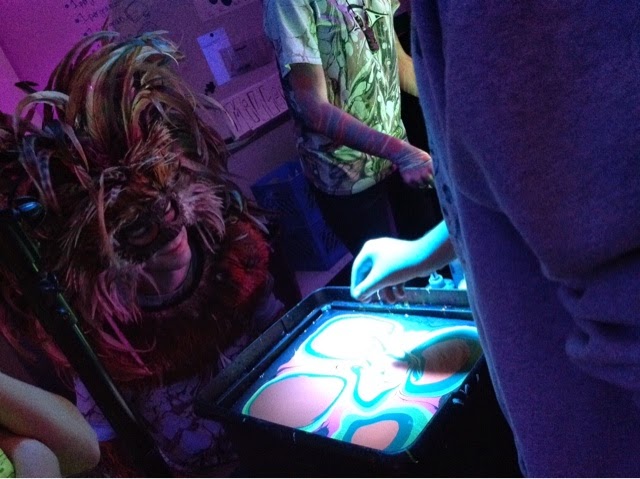
I can not come close to expressing in words the amount of joy, wonder, and excitement that filled my room yesterday afternoon.  BLVisuals let each student pick their own colors for a bandana - swirl them as desired and help dip, rinse and dry.


While students were waiting for their turn at dipping or simply trying to be patient while their creation dried - the group at BLVisuals brought along some fancy glasses that order colors in your depth of field.  Hot colors in the front (closer to you) and cold colors in the back (further from you) giving anything with hot and cold colors an element of 3-D!  It was amazing! Students loved looking at posters and their bandanas with the glasses.

Students were also excited and encouraged to take their tapestry/bandanas and hold them in front of color changing lights - which in turn, magically, changed the colors on their bandanas! 

Every year each of the arts teachers in my building are in charge of bringing in an artist from our field.  Our AMAZING PTO sponsors these visiting artists and their workshops for our kids.


Pretty sure my students would describe the visit as "Best Day Ever".


BLVisuals dips most anything fabric and frequently travels to festivals and dips patron's arms.  Their paint is a unique blend of acrylic paints - their beautiful creations on skin last about the length of a temporary tattoo while being permanent on fabric.

It was a truly awesome day.

10.18.2013

Art and the MEAP (Michigan Educational Assessment Program)

Wow!  How has it been almost a month since I posted last?!  Time flies when you are having fun!

The last few weeks have been packed with craziness - I was sick for a bit, field trips, National Testing for the upper grade levels - it's honestly been kind of a mess.

I halted all 3rd, 4th and 5th grade projects for the last two cycles due to MEAP tests.  I realized that their brains were complete toast by the time they got to me and we needed to do some relaxing, other side of the brain thinking in art.  My goal was to not only rest the one side of their brain, but to re-energize and almost reset their day.

My fourth graders were finishing up their collages from their visiting artist and while this is a 'simple' enough task - it wasn't the kind of way I wanted them to use their brains.  Instead we worked on a value project where they needed to mix colors and paint - much more therapeutic. 

We started out by BRIEFLY looking at pictures of the moon at night.  (*Normally I would make the observation part longer, but it is not what the kids needed this week.  Also, the kids are observing the moon in science!  Who knew!).  We talked about what they saw - the colors, the sky... etc.  Next, I showed them how to use a safety compass.  (Honestly, best compasses EVER!).  They drew concentric circles.

At this point some classes were done for the day because I only saw them for 20 minutes - other classes got a chance to get to the paint.  I set out trays with white, black, blue, and purple.  The students painted their moon white, the first ring was their sky color with white, then after that they added a little bit of black for each circle till it got darker and darker and darker.

Students went from loud and squirrel-y to mellow and focused.  I asked the group how their brains felt - many replied with a sigh and a 'much better'.

This lead me to realize that I could help out the grade level teachers as well as the kids.  I sent out an e-mail to the teachers suggesting that they do a little bit of art after their testing.  It wouldn't need to be much 10-20 minutes and it could be as easy as coloring a geometric coloring page.  The rhythm of coloring/painting helps to calm and refocus the brain.  I know that in college during finals I would put out a stack of coloring books and all my crayons in the common area.  Almost everyday I would find the majority of my suit mates bent over coloring books after long bouts of studying or tests.  They would exclaim how much better and more relaxed they felt.

After I sent out my e-mail offering to print some coloring pages - one of the 4th grade teachers e-mailed me back.  She said that their writing assignment that day had to do with some characterization and instead of jumping right into the writing she had them spend some time drawing their character - she said the lesson went smoothly and the students produced a lot of information about their characters!

---------

My third graders have been hard at work exploring landscapes (horizon lines, foreground, middle ground, back ground... etc).  So, again, I decided that wasn't quite the way I wanted to exercise their brains after a morning of MEAP testing.  So, we took a break and did chalk leaf piles.  I have done this lesson for quite a few years now - and they always turn out beautiful.  The students fold a piece of card stock in half, draw half a leaf, cut out the leaf in one long cut!  They should have two stencils - a positive and a negative.  (Sometimes it takes kids a few tries to get it.)  Next they charge their stencil with leaf colored chalk, place the stencil on their paper, smear the chalk from the stencil to their paper.  The students repeat this process with both stencils and then with each others stencils until their paper is filled - overlapped leaves and leaves that go off the edge.


Again, students start out loud and a little over the top - by the time they start using chalk the energy and noise level evens out.


--------
5th grade was a little bit different.  They were finishing some 2-point perspective words and then starting their t-shirt designs for 5th grade production.  So, while I didn't restructure their lessons like the other two grades - their assignments already focused on using their brain more creatively.


9.21.2013

Visiting Artist: Elizabeth St. Hilaire Nelson of Paper Paintings

Her cows are my favorite!
Total awesomeness!  Elizabeth St. Hilaire Nelson of Paper Paintings came to one of my schools and talked with my fourth graders!!!

Okay, lets back up to before the awesome visit and talk about how we prepared for the event!

A couple of weeks before Mrs. Nelson came I passed out a bunch of pictures (from a calendar) of her work and asked students to look at them - notice them.  We then talked about things they noticed, what the pictures had in common, what was different and even came up with some questions for the artist.


Next we watched this short video:


After the video the kids were pumped and we set off to decorated some collage papers with crayons, tempera paint and watercolor.  I assigned tables a specific color so that we had the correct color combinations when we went to collage later.

The following week we watched a DVD that Mrs. Nelson sent me.  In the DVD she went through her process from beginning to end - making papers, sketching, under painting, and then collaging.  After the video students did their own "sketching" and under painting.  Normally I am against making all the students do the same exact thing, but this time I decided the students needed to focus on the visiting artist along with the collage process - so I decided they would do our school logo.  We have a die-cut of our logo in two sizes, so I made a bunch and let my students pick which size and where to place it on their 6" square pieces of wood.


Back to the amazing visit:

Mrs. Nelson began by talking my students about her love of art, her journey to where she is now with art, and specific techniques to her collage style - and maybe most importantly she explained that making art is her job, she gets paid to make art! After her powerpoint she demonstrated how she works - she impressed the kids with her ability to work on her artwork on planes, in doctor offices and anywhere she can sit for a few minutes! The students "ooo-ed" "aww-ed" and whispered "this is awesome" "so cool" "best day of art ever"!

So, after Mrs. Nelson demonstrated how to directional rip, placing glue UNDER and OVER each piece, correct mistakes, and all sorts of other tips and strategies - we passed out glue, paint brushes, collage papers and their block of wood.

The students TOOK OFF! It was AMAZING to watch them work.  They totally understood and went for it.  Some students used too much glue, others too little - but everyone learned by trial and error and their projects look amazing.  When we had to clean up all I heard were complaints and moans - which is always a good sign.

I think one of the best things about the day was how much my students loved her right from the beginning.  They brought paper for autographs and gave hugs left and right.  Hopefully Mrs. Nelson had a great day just like my students and I did.


9.07.2013

First Project

This student went to Germany and Austria!
I have tried multiple types of 'first projects' over the year - names, portraits, just jumping into projects and others.....

I *think* I may have found a solution - a project I really love for the first day of art class.

This is the 3rd year at these two schools and I really do love all my kids - so much that it bothers me I can't talk with each and everyone about how awesome their summers were.  Which inspired this years first art project - well that and pinterest.

This student went to a water park (I love how he started off the page)


I found this awesome project on pinterest, and while the page is in German - the pictures explain enough.  Each student gets a square piece of paper with a quarter circle on it, they then decorate it and when assembled together the quarter circles form a large circle.

I used the pinterest idea and made my squares with a quarter circle on them.  Then in class I spent 5-10 minutes calling on kids and having them tell me something about their summers.  I wrote it down on a LARGE word web on the board.  It was fun to see what states they went to, what water/amusement parks and all sorts of other cool things.

I then explained that I was going to give them a square with a quarter circle.  I asked them to rotate their paper till the arch would work with their assignment.  Their goals were 1) FILL the space  2) Use pictures that represent their summer  3) use colors that make sense.  The catch is that they needed to USE the arch in their picture and not just draw over it.  They also only had that one first class to finish it - which turned out to be anywhere from 10-20 minutes.  I encouraged them to either pick one totally awesome thing to draw or combine as many things as they wanted!!!

The braces this student got over the summer is the sun!
This project was totally awesome!  Not only did I hear highlights from my kiddo's summers, then get to hear even more while I walked around - but ALL kids succeeded in their very first art project.  There was no, 'I can't do this' 'this is stupid' blah blah blah.  All the kids were excited to draw about their summer.  It also provided me with a quick glimpse on abilities of my new students, how attitudes have changed over the summer, and the work habits of the students.

At the end of class I made sure to have students write their name and teacher on the back - then I put them on a bulletin board.  I love that there is already artwork up in the halls, and MANY teachers stopped to look and express their happiness of having artwork up as well!!!

Top Left: A baseball game  Top Right: One of those scary funnel water rides and camping.  Bottom Left: Plane rides and amusement parks.  Bottom Right: The Zoo and Mackinaw Bridge.


5.06.2013

1-5th Grades -- Stop Motion Animation (Week 1)

I have always wanted to do a stop motion animation project with students but was overwhelmed the the amount of equipment I would need -- cameras, tripods, computers, computer software, a computer lab.... times however many groups I would have.

Then came iPads and iPad apps.  Sometime during the summer or fall I found an app called 'Stop Motion'.  It's a .99 cent app that is super user friendly that creates stop motion animation -- you can do all sorts of things directly in this app to have a full video of awesomeness.

Now that I found the app I just needed enough iPads - which was almost as overwhelming as needing ALL the extra equipment.  Lucky for me our building purchased a few iPads for teacher/student use.  I claimed the iPads for two weeks in May to try out stop motion animation!

I waited.  I planned.

May came and suddenly it was time to load up the iPads with Stop Motion and pray to the art teaching gods that my lesson plan would work.

The week before I drew out some backgrounds on some old file folders and asked students to color them when they were finished with work.

I also took some GIANT white paper, an iPad, and a ruler to grid out the sight lines of the camera.  I had students color this grey.  

The day came to put all my planning to the test - about 20 minutes before my first class walked in I tried to download the .99 app only to find no way to purchase the app and download it on each iPad.  (rightfully so, the school ipads did not come with a credit card on file).  I started to panic.  Would I really need to buy 10.00 gift cards for each one for a 99 cent app?!!?  Then I got smart.  I gifted Stop Motion to myself 4 times and redeemed them on each ipad.  WHEW.  That was close.


How I set it up:
3-5 kids in a group depending on how many students are in class (I had 6 stations)
1 Large white paper with grey trapizoid
1 background
1 iPad loaded with Stop Motion
Pattern blocks
1 ruler to angle iPad

I explained how the app worked, their job, how to rotate through being the director, and stressed as much as I could to NOT MOVE THE IPAD OR THE BACKGROUND.


One student is the Director at a time.  The director's job is to make sure all body parts are out of the shot- take the picture - then tell group to move pieces.  I set a timer for 2 or 3 minutes (depending on group size).  When the timer goes off directors change.  The director doesn't get to boss around what the movers do - their only job is to clear the picture of body parts and take the picture.  The group works together to make ONE long video - the video DOES NOT change when the director does.

The lesson worked even better than I expected.  The kids used the app with little help or instruction.  I did find that the older students did a better job being patient and moving pieces a little at a time - the younger kids seemed to get excited and make larger movements between pictures.

Towards the end of class I have groups clean up their stations while I collect their iPads and turn on the projector.  When everyone is cleaned up we watch their movies on the digital projector.  (All you need is an adapter that goes from your iPad to VGA cable for the projector).

Overall the lesson was a complete success - I have parents e-mailing asking what app it is, students are begging to do it again next time (which I already have planned!)


5.02.2013

3rd and 4th Grade -- CD weavings

Last year at the end of the year our building Tech came to me with a box of CD's asking if I could use them.

SURE! I said.

Fast forward to this year and suddenly CD weavings are popping up everywhere - Pinterest, other art teachers in my district, blogs.  I decided to jump on the band wagon and give it a try!

I started kids out with a CD, or rather their LOOM.  Next, I gave them a piece of warp thread - it was my wingspan,  about 5 ft.  Students put the warp thread through the middle of the loom and tied a TIGHT square knot on the back.  Next, students wrapped the remaining thread through the middle, then around the outside edge, until they ran out of thread.  Then, students counted how many strings they had on the front - they needed to have an ODD number (most had 11 or 13, a few 9).

IMPORTANT: The tighter the warp thread is on the loom the easier it will be to weave.

Next class I showed students how to measure a piece of yarn using their arms as a measuring stick - finger tips to shoulder, then how to thread the yarn on a tapestry needle. (HINT: my mom taught me this-- don't use the end of the string, instead make a little loop, pinch the top of the loop to make a bump, put the eye of the needle on the bump, wiggle the bump a little and it will slide right into the eye!).  Do not tie on the needle.  Students learn quickly to pull the thread not the needle when pulling weft thread tight.

Students then pick a spot on their warp thread, put the needle under, over, under, PULL - pull till the end of the string almost goes under that first warp thread.  Hold down the end of the weft thread while you continue with the needle all the way around - over, under, over, under.... when you get back to the beginning the weft string will overlap the end and hold it in place.  Weave till you run out of string.  When the string runs out - end it on an 'under' movement.  Measure new string, start where the last string ended and keep going!  (video to come)

The first couple of strings were the most thought provoking for the students - but after that they CRUISED!  In fact students would beg to take them home to work on them and would exclaim with excitement when they would return to finish them!

To be done students could either weave to the very edge or stop about an inch short and color with Sharpies.

I will totally do these again!

***NOTES***
- Make warp thread TIGHT.
- Make sure there are an odd number of warp threads.
- Make students thread their own needles.
- Don't let students tie on their needles (unless absolutely needed)


4th Grade - I Am Poems

I originally saw this project either on Pinterest or a blog.... I can't remember anymore.  The original post was with a 1st grade class where the kids painted the background, a candid picture was taken, and a sentence was added.  I LOVED the personality of these and decided to make it a little harder.  In my old district the 3rd graders created these fantastic poems based off the book "I am America" that I decided would be PERFECT for my project.

So, the first day I had students watercolor their paper using liquid watercolors and salt.  I asked that they do abstract paintings - using only lines and shapes, no smiley faces, no Michigan S, no suns, no hearts (I realize hearts are a shape), and so on.  The students were so intrigued by what the salt did to their paintings that they didn't even think about adding cute-sy images.

Day two I had the kids write down 15 things about themselves on a piece of paper - I gave them 10 minutes to do this.  I asked them to write a word or two for each thing, no sentences.  (Have you ever watched a 4th grader compose a sentence?!? oh boy.)

Next I read them "I am America".

After we talked about patterns in the book - how it was worded.  Does it make sense to say, "I am blue jeans?"  -- What does that mean?  Does it actually mean the person is made of blue jeans?!  We discuss and when I felt like the kids got it I introduced the next part.

On the back of their paper students write 10 sentences combining their ideas about themselves and the wording from "I am America".  So, for example if I wrote, "green" on the front, on the back I might right, "I am bright green fresh cut grass."  Or if I wrote, "cheese pizza" on the front, on the back I might right, "I am gooey hot cheese pizza".

My goal was to get students to stretch their sentences to be more than "I like pizza".  Most students enjoyed coming up with words like, dazzling  shimmering, bold, loud, awesome... etc.

The next time I saw students I booked the computer lab and I had students type their 10 sentences.  I figured this would take 15-20 minutes.. BOY WAS I WRONG!!  Have you ever watched 4th graders type?!?!?!  WoW.  It took them a full 50 minutes and even then some were finishing up.

I had students type all 10 sentences first, THEN if they had time students were allowed to go back and change fonts, colors, and sizes of their text.  We printed them out and kept them till next class.

The very last day of this project I printed out pictures I took of them, handed them their poem and asked them to cut neatly!  Then they arranged their poem AND their picture to make a unique composition.  Last but not least - it all got glued down.

These are breathtaking to look at.  The contrast between the bright background and their black and white pictures are perfect.

This project took many classes to do, but the end product was well worth it.

**NOTE** To protect images of my students the pictures presented are cropped and do not show full project.