Today I had the privilege to attend an Arts PD at our local University. This PD wasn't for just visual arts - but for music, dance and theatre. The original brochure seemed vague - the day was to be dedicated about teaching for student expression. No keynote, no session to pick between - I wasn't really sure what we were getting into. All I knew was that the district was paying for us to go and I would get to spend the day talking about what I actually do instead of talking about reading/math or some other initiative that I would need to modify/alter into my room. So, I figured, even if it wasn't a great conference, it would be WAY better than the alternative.
Well, as it turned out - it was fabulous. The seemingly vague brochure was right on target- we spent the day around the theme of 'expression' and there weren't keynotes or labeled sessions because it was very organic. There was light direction, but that was it - the attendees were allowed to move through the day and be inspired where they were at.
We watched and experienced a bunch of university students in their craft. We talked with them in an honest dialogue about how they got to where they are - what inspired them. Where or who made them decide to major in the arts.
We talked in breakout session with our colleagues about key words and phrases about what we teach, why we teach. We came back together and shared those lists.
We ate a FABULOUS lunch which included some of the best chocolate cake, well besides my mom's.
In the afternoon we watched a professional dance group that is doing a residency at the university. They have a very unique company which provides a lot of improv from the dancers as well as the audience and composer. It was beautiful, and surprisingly moving. I found myself lost in the movement along with the composition - tears stinging in my eyes.
In one of our table talks, when we were wrapping up our day - our discussion leader looked at me and asked, "So, when do you have time to make your own art?" I am sure this was meant to lead into the fact that many art teachers don't have time or the energy to keep up with their own work.... but I was never an artist first. Many arts teachers started out as a musician or visual artist first - then decided to teach. I'm one of the few that didn't fall into art education that way. I went through school feel stupid. I didn't mind school - but it sucked for me. I was good at art, enjoyed art. I loved doing crafts at home - making bracelets, painting, pearler beads..... but that was never viewed as 'important' or 'smart'. It was seen as cute and crafty. It wasn't till college that I had my moment where I went "huh - this is how normal people feel in class". I was sitting in my weaving class and one of the only students who 'understood' the warping board and how to dress a loom without notes. It was in the moment where I went "no one expressed to me that art could be a job - that I was smart and good at something I could make a living at". So, I went into art education wanting to be the person I never had.
I think though - when looking back on the day, the most powerful part was realizing that we spent the ENTIRE day talking about teaching and students and the word 'rubric' 'lesson plan' 'student growth' 'data' weren't really mentioned or key noted in any discussion. When we discussed what we teach- no one mentioned a lesson, or color theory, or perspective -- it was all about opportunity, mistakes, failing, asking for help, trying again, trusting, and exploring. The arts teach their own skills and foundations based on their craft, but what everyone is really teaching is expression and how to start, fail, try again -- how to preserver. The arts are beautifully, gorgeously messy.
Showing posts with label Passion. Show all posts
Showing posts with label Passion. Show all posts
11.08.2016


10.16.2015
::Happy Sigh::
My last post was about how burned out I felt and how I was terrified that I wouldn't love my job anymore.
Well, we are seven-ish weeks into the school year and it's amazing! I really do love my job. I am a little weary that we are still in the beginning of things, but so far so good. I have really ENJOYED my students so far this year. Whenever I get stressed out, I try and remember to put it aside and be present at the moment with my kids. Am I perfect about it - heck no, but things are WAY better. My students seem happier too - they seem more willing to run with ideas and go for things - which could totally not be true.
I have a lot of posts and projects to update about - lots of neat ideas I have gathered and then introduced to my kiddos. I will try and get some posted today, but first I have some bulletin boards I need to finish.
For more timely updates and pictures of what is going on in my classroom - follow Organized Chaos on Facebook.
Well, we are seven-ish weeks into the school year and it's amazing! I really do love my job. I am a little weary that we are still in the beginning of things, but so far so good. I have really ENJOYED my students so far this year. Whenever I get stressed out, I try and remember to put it aside and be present at the moment with my kids. Am I perfect about it - heck no, but things are WAY better. My students seem happier too - they seem more willing to run with ideas and go for things - which could totally not be true.
I have a lot of posts and projects to update about - lots of neat ideas I have gathered and then introduced to my kiddos. I will try and get some posted today, but first I have some bulletin boards I need to finish.
For more timely updates and pictures of what is going on in my classroom - follow Organized Chaos on Facebook.
8.26.2015
Burnout
Okay. Let's be honest for a moment - the last handful of years have been tough for me in the teaching world. There have been lots of changes, and shifts in my professional realm that haven't all been easy to understand, accept, or adapt to. During these changes, I tried to give the benefit of the doubt, I tried to be positive, I tried to express my thoughts and ideas.... But I kept feeling mad, disappointed, and the worst - frustrated. I felt like everything was a fight. I felt like giving up.
I felt so burned out.
I spent a lot of time trying to figure out
why I was so emotionally exhausted and fried. Did I feel frustrated and burned out because of all the changes and shifts, or because every year my job has to survive the chopping block in April when the budget has to be balanced, or from constantly having to defend and advocate for the arts, or perhaps the "honeymoon" period was finally over after 8 years. My conclusion - all of it. All of it was a contribution to my burnout.
So, when the school year ended last spring and I packed up my classrooms, I decided to take the summer off - like off, off. No planning lessons in July, no planning the years units in August, no workshops, no school related books, no school email, no blog posts, no going in early (which I did break for a day). I decided to take a real break from it all to try and adjust my attitude - to let the burn out wash away.
Did it work? I don't know.
Teachers report back next week. I am anxious, as always, but also afraid that my burnout hasn't gone away. To be honest, I am terrified that I won't love my job like I use to. I use to be so sure that my vocation, or calling, was teaching art. I am afraid that I may have fallen into that young professional teaching statistic of burnout. I hold onto the hope that I am just in a rut - that, like everything in life, there is a fluidity to it and if I hold on long enough, it will circle back.
My plan this year is to let go of everything I don't have control over, which I know is way easier said then done. I lost a lot of energy and a lot of momentum the last couple of years fighting and stressing over things I had absolutely no control over and I can't do it again. It's not good for me, it's not good for my students and it's not good for my program. So, a new year, a new plan - it's all about my kids in my classroom, it's all about making art and thinking like artists - it's about celebrating mistakes and learning to preservere, it's about providing kids with a different way to think and succeed. I can't control if the district decides to tank the arts, or a slew of other things - so let's live in the moment we have and not worry about the future. I have this year to make a difference in the lives of my students - one day, one art class at a time. A friend of mine, who has provided lots of inspiration over the years, has coined the #everydaymatters and I think I will follow him in this journey. I need to reconnect, refocus, and be present with my kids this year, because everyday does matter.
So, here is to a new school year. A new vision, a new attitude, and hopefully a renewing year.
(I typed this post on my phone - please forgive any mistakes.)
12.19.2014
"You're a fun activity once a week"
Did the title of this post make you cringe? It certainly took me off guard when a co-worker said this to me.
 I was in her office talking about something - venting most likely about something ridiculous that was happening, but I can't remember what exactly. All I remember was talking to her and saying something about how what I do is important too and she agreed by saying "you're a fun activity once a week".
Ouch.
I am certain she meant it as a compliment. I am certain she has no idea how much it felt like a sucker punch.
I NEVER know how to respond to comments like these, especially when I don't see them coming, especially when they come from people who I thought understood what I really do. I just don't know how to respond.
 Over the next few days this comment rolled around in my brain from time to time. What really bothered me about this comment? Did it bother me because it was partly true? Did it bother me because I feel I am so much more than a "fun activity"? And the answer is yes, yes to both.
Art is once a week and it is fun - so yes, art is a fun activity once a week. Maybe this isn't such a bad thing after all. I mean, when you think about things that are 'fun' what do they have in common generally -- laughter, good feelings, people, communication, engagement, the confidence to try something new and more. I am happy to say that often the art room is all these things.
 I think the part about the comment that bothered me was that while art IS fun, its not the purpose of art. The purpose isn't to be fun, fun is a byproduct of doing something creative. Being creative is naturally fun - it's engaging, it's interesting, it often provides natural problem solving and critical thinking, and even natural communication points. I never plan a lesson to be 'fun' - it just happens when lessons are full of engagement and opportunities to make creative choices.
So, yes, while art is a fun activity once a week - that is not the purpose of art. The purpose is to provide young minds with another way to think, a space to take risks and not even know it, to grow problem solving and critical thinking skills, and to become more themselves.
In the meantime, I will try and come up with a variety of retorts to comments such as these that will help to educate those who think art is just 'fun' while honoring and owning the positives in such comments.

Ouch.
I am certain she meant it as a compliment. I am certain she has no idea how much it felt like a sucker punch.
I NEVER know how to respond to comments like these, especially when I don't see them coming, especially when they come from people who I thought understood what I really do. I just don't know how to respond.
 Over the next few days this comment rolled around in my brain from time to time. What really bothered me about this comment? Did it bother me because it was partly true? Did it bother me because I feel I am so much more than a "fun activity"? And the answer is yes, yes to both.
Art is once a week and it is fun - so yes, art is a fun activity once a week. Maybe this isn't such a bad thing after all. I mean, when you think about things that are 'fun' what do they have in common generally -- laughter, good feelings, people, communication, engagement, the confidence to try something new and more. I am happy to say that often the art room is all these things.
 I think the part about the comment that bothered me was that while art IS fun, its not the purpose of art. The purpose isn't to be fun, fun is a byproduct of doing something creative. Being creative is naturally fun - it's engaging, it's interesting, it often provides natural problem solving and critical thinking, and even natural communication points. I never plan a lesson to be 'fun' - it just happens when lessons are full of engagement and opportunities to make creative choices.
So, yes, while art is a fun activity once a week - that is not the purpose of art. The purpose is to provide young minds with another way to think, a space to take risks and not even know it, to grow problem solving and critical thinking skills, and to become more themselves.
In the meantime, I will try and come up with a variety of retorts to comments such as these that will help to educate those who think art is just 'fun' while honoring and owning the positives in such comments.
11.21.2014
BLVisuals @ Stadium Elementary
11.14.2014
4th Grade Visiting Artist: BLVisuals
 I can not come close to expressing in words the amount of joy, wonder, and excitement that filled my room yesterday afternoon. BLVisuals let each student pick their own colors for a bandana - swirl them as desired and help dip, rinse and dry.
While students were waiting for their turn at dipping or simply trying to be patient while their creation dried - the group at BLVisuals brought along some fancy glasses that order colors in your depth of field. Hot colors in the front (closer to you) and cold colors in the back (further from you) giving anything with hot and cold colors an element of 3-D! It was amazing! Students loved looking at posters and their bandanas with the glasses.
Students were also excited and encouraged to take their tapestry/bandanas and hold them in front of color changing lights - which in turn, magically, changed the colors on their bandanas!
 Every year each of the arts teachers in my building are in charge of bringing in an artist from our field. Our AMAZING PTO sponsors these visiting artists and their workshops for our kids.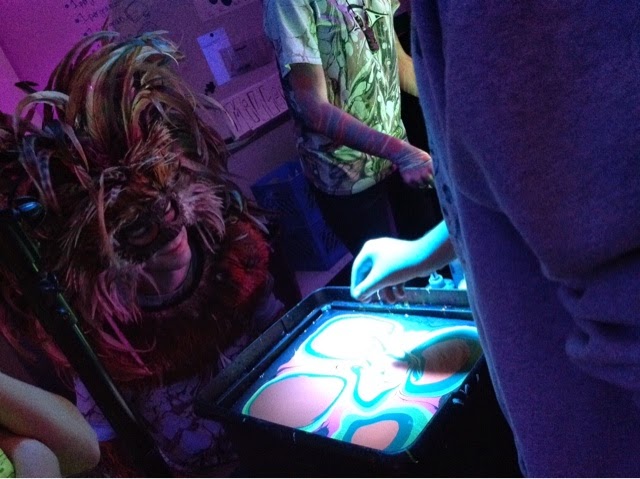


Pretty sure my students would describe the visit as "Best Day Ever".


It was a truly awesome day.
9.19.2014
Second Full Week
Today ends the second full week of school. To be honest, it is finally starting to feel awesome to be back in the groove. This was the first year that I didn't feel ready to come back, I was mourning the loss of summer. I think a lot of it had to do with the fact that last year was a pretty rough year. There were a lot of changes in my school that I was struggling with embracing or even simply accepting. This year is a bit better, mostly because I am making a conscience effort to have a better attitude - to accept the things I can not change, and to embrace and love the things I can. There are better days than others, but it totally helps that I have some totally rockin' colleagues that are helping me to keep me accountable.

On top of having an overall better attitude, I am rediscovering my love of teaching. I am remembering how much fun it is to teach art. Last year I felt annoyed quite a bit by my students choices and behaviors and while some of it was warranted - it was mostly me just being grouchy. So this year - a clean slate for all, including myself.
I have set my standards high for myself and my students. I remind students quietly and gently (unless there is safety involved). I am hoping that if we can start out the year with love, trust, compassion, a sense of humor, and consistent expectations/consequences that the students and I can have an even more productive and highly engaging year. So far so good, though it still is the end of the second full week!
I started off the year by asking students to show me about their summer on a piece of paper. I did this project last year and LOVED it. It takes only one day and I get to catch up with kiddos - I can start building those relationships with the kids that need a little extra love to feel comfortable to succeed. It gives me a chance to practice procedures and protocols without yacking at them for 50 minutes. I also have a chance to fill bulletin boards with work for curriculum night the first week of school.
Our first 'real' projects began the next time I saw them. I am hoping to include some more 'skills' into their work this year without doing too many "draw like this" lessons. I really love having them be creative and stretch their own ideas - but I also am seeing some holes in their skills that I need to try and boost.
 For the upper grades (3-5) I am starting guided sketchbooks this year. Each day they come I hand them a half sheet with some kind of guided drawing/thinking lesson. The students then work on them for 5 minutes without talking. I am hoping these will help boost their drawing skills, their observational skills, their confidence, their patience, and even their problem solving skills - as I answer no questions during the five minutes, nor do I answer "is this right?". Before we started the sketchbooks I explained to the classes that it is about warming up the creative side of their brain. In PE, dance, or music they do warm ups to prepare their bodies/voices - in art we have to wake up the creative side of their brains.
 So far I have classes that really have embraced the 5 minutes and others really struggle with not asking for help or looking for the 'right' answer. I ask them to do their best and to work for the WHOLE five minutes. It has been interesting. So far it seems that the classes that really embrace the 5 minutes seem to be more focused on their work come work time - instead of it being social hour. I will try and remember to report back at the end of the year to reflect on how it went over the course of the year.
 After the students do their warm up sketchbook page for 5 minutes - they add it to their sketchbook and prepare for that days lesson. If students finish the day's lesson they go back and finish their sketchbook page(s) before they can do something off the Finished List.
I am doing my best to step up my program in a way that we all work smarter, not harder -- hopefully my new school year resolutions will hold throughout the year!

On top of having an overall better attitude, I am rediscovering my love of teaching. I am remembering how much fun it is to teach art. Last year I felt annoyed quite a bit by my students choices and behaviors and while some of it was warranted - it was mostly me just being grouchy. So this year - a clean slate for all, including myself.
I have set my standards high for myself and my students. I remind students quietly and gently (unless there is safety involved). I am hoping that if we can start out the year with love, trust, compassion, a sense of humor, and consistent expectations/consequences that the students and I can have an even more productive and highly engaging year. So far so good, though it still is the end of the second full week!
I started off the year by asking students to show me about their summer on a piece of paper. I did this project last year and LOVED it. It takes only one day and I get to catch up with kiddos - I can start building those relationships with the kids that need a little extra love to feel comfortable to succeed. It gives me a chance to practice procedures and protocols without yacking at them for 50 minutes. I also have a chance to fill bulletin boards with work for curriculum night the first week of school.
Our first 'real' projects began the next time I saw them. I am hoping to include some more 'skills' into their work this year without doing too many "draw like this" lessons. I really love having them be creative and stretch their own ideas - but I also am seeing some holes in their skills that I need to try and boost.
 For the upper grades (3-5) I am starting guided sketchbooks this year. Each day they come I hand them a half sheet with some kind of guided drawing/thinking lesson. The students then work on them for 5 minutes without talking. I am hoping these will help boost their drawing skills, their observational skills, their confidence, their patience, and even their problem solving skills - as I answer no questions during the five minutes, nor do I answer "is this right?". Before we started the sketchbooks I explained to the classes that it is about warming up the creative side of their brain. In PE, dance, or music they do warm ups to prepare their bodies/voices - in art we have to wake up the creative side of their brains.
 So far I have classes that really have embraced the 5 minutes and others really struggle with not asking for help or looking for the 'right' answer. I ask them to do their best and to work for the WHOLE five minutes. It has been interesting. So far it seems that the classes that really embrace the 5 minutes seem to be more focused on their work come work time - instead of it being social hour. I will try and remember to report back at the end of the year to reflect on how it went over the course of the year.
 After the students do their warm up sketchbook page for 5 minutes - they add it to their sketchbook and prepare for that days lesson. If students finish the day's lesson they go back and finish their sketchbook page(s) before they can do something off the Finished List.
I am doing my best to step up my program in a way that we all work smarter, not harder -- hopefully my new school year resolutions will hold throughout the year!
4.04.2014
Thanks Jeremiah
This week I had a small group of students come to art a few minutes early. I always love moments when I have just a handful of kids, especially the normally quiet kids, because I get a chance to really hear them. These students had just come from a pull out support group for reading.
 One kid, we'll call him Jeremiah, puts his head on the table, looks and me and says, "I don't like school."
There was a pause. I am never really sure how to respond to this statement.
He then proceeds to say, "I don't like most of school. I do like art and P.E."
I asked him why he liked those parts of school.
He took a second and said, "I like art because I get to do things like paint and create. In P.E. we get to run and play games."
I can't remember what I said, or if class came in - this quick conversation not only made my heart break but reminded me of why I do what I do.
I teach art for kids like Jeremiah. I teach art for kids that 'learning' is a true struggle. They have to work 3x as hard to learn the same information as "normal" kids -- everyday, for 7ish hours they struggle -- then 2ish times a week, they get to be "normal" - they don't have to work so hard, they can enjoy learning.
I teach art for the kids that need a place to smart, to overcome their dyslexia, their ADD, their processing delays -- I teach art to gives kids a place to feel like everyone else, while becoming more themselves.
Thanks Jeremiah for refreshing my perspective.
One kid, we'll call him Jeremiah, puts his head on the table, looks and me and says, "I don't like school."There was a pause. I am never really sure how to respond to this statement.
He then proceeds to say, "I don't like most of school. I do like art and P.E."
I asked him why he liked those parts of school.
He took a second and said, "I like art because I get to do things like paint and create. In P.E. we get to run and play games."
I can't remember what I said, or if class came in - this quick conversation not only made my heart break but reminded me of why I do what I do.
I teach art for kids like Jeremiah. I teach art for kids that 'learning' is a true struggle. They have to work 3x as hard to learn the same information as "normal" kids -- everyday, for 7ish hours they struggle -- then 2ish times a week, they get to be "normal" - they don't have to work so hard, they can enjoy learning.
I teach art for the kids that need a place to smart, to overcome their dyslexia, their ADD, their processing delays -- I teach art to gives kids a place to feel like everyone else, while becoming more themselves.
Thanks Jeremiah for refreshing my perspective.
1.26.2014
If You're Not Prepared to be Wrong....
A very eloquent and wise man, Sir Kenneth Robinson, once said, "If you're not prepared to be wrong, you will never come up with anything original".
 Whats the difference between the schools? Socioeconomic? Atmosphere? Personal relationships?
Not only do I feel this statement is very much true - but it happened in my classes the other day. I was working with my 2nd and 3rd graders on their piece of artwork for Young Masters. I always do projects that are high success, but also highly original - I decided that 2nd and 3rd graders would be doing zentangles this year. I know all my students can create with lines and shapes, but this would be one of the first times I would not be allowing pencil first - but straight to Sharpie.
To get my students creativity warmed up for this project I showed them part of a zentangle video on youtube. I asked them questions like, "What are they drawing?" -- I would get a laundry list of answers like: scales, hills, bumps..... I then would ask the question again. The students seemed confused. I would wait a few seconds and there was always one kid that would see through the design and realize they are actually drawing curved lines which then remind us of things like hills, scales, bumps...
So we go on with the video and notice they use squares, circles, dots, straight lines, coloring in spaces and leaving other spaces open. We discuss pattern and rhythm in each section. I then asked the students if they know how to draw straight lines, curved lines, squares, circles -- etc. They agree they know how and are starting to get real excited.
I then explain that they will be doing a warm up zentangle on a post-it. They will be doing it with a Sharpie and any 'mistakes' they make will need to be problem solved and pulled into their design.
This is where it got interesting.
At one of my school the kids were excited and ready for the challenge. In fact I had to wait multiple times for them to stop talking so I could finish my instructions - they were so excited they couldn't wait to share their ideas! They were jumping at the bit to skip pencil and use sharpie straight away!
So then at the end of the week I went to my other school and these kids panicked. Full out, panicked. They were almost arguing with me to use pencils or to get an extra paper incase they messed up. I spent far more time with these kids building up their confidence and convincing them they would be fine. The post it note was just practice and it was okay if they didn't like it in the end.
Whats the difference between the schools? Socioeconomic? Atmosphere? Personal relationships?
There are many small differences between the schools - but they are mostly the same. My kids at the school that panicked are often better at following rules and expectations, but their socioeconomic status is similar to the other school, and most of the kids, at both schools, I have had 2 or 3 years -- so our relationship is pretty strong. I personally believe that the reason I had students in one school panic and the others not is due to the fact that non-panic school is a school of the arts.
My school that is a school of the arts is NOT a fine arts school. We are not a school that trains kids in the arts - we have no band or dance troupe. Instead we infuse arts into the whole educational system. Students transfer and connect ideas between classes - they learn about texture and patterns - they are asked to compare relationships, look for symbols...etc across disciplines. These students also have dance and drama in addition to their 'normal' special schedule.
Kids that come to the school for the arts are continuously asked to take chances, take risks, throw out an idea, perform in a small skit, join in conversation, think about something from a different point of view, problem solve and critically think about questions. Students at this school are prepared to be wrong, to make mistakes. Students at this school are encouraged to take a chance, and are supported through their thinking/exploration. While music and art provide this -- dance and drama really help to drive these concepts and ideas home. Asking kindergarteners to act out simple fairy tales, teaching 3rd graders to do improv -- it not only enforces their reading/writing skills -- but teaches them to 'prepare to be wrong'. In dance they are asked to come up with movements that inspire or represent a concept/word/idea. Students at this school are asked to explore answers instead of giving the correct one.
Now, lets take a moment and realize that my other elementary school is VERY supportive of their students. Students feel safe and get a an amazing education there. Students are very thoughtful and take learning risks there as well -- but in a different fashion.
I truly believe that both my schools offer an exceptional education to students and the point of this post is not to give more props to one over the other, but to try and understand why two similar groups of kids would respond so differently to the same project.
Back to the project. As the students were doing their warm up post-its. I had them work silently for 5 minutes. I wanted the to really concentrate on their visual thinking and felt talking would be too distracting.
After the 5 minutes was up - I let them share their ideas from their tables, then bring them to me. I put them on the board and we quickly discussed that when they were working on their 'final' paper that if they needed some inspiration that they could come look at their class's thinking for ideas.
It is important to note that after the warm up both schools were ready and raring to go, and that their warm up thinking/solutions were very comparable. The warm up provided my traditional elementary school students with the chance to be wrong and when they worked through those mistakes without an eraser or a new paper - they had the confidence to be original, just like my school of the arts kids.
So in the end both sets of students had the same outcome - but that initial jump into a project was so very different. As much as working at two buildings can be frustrating - moments like these, I find fascinating.
So in the end both sets of students had the same outcome - but that initial jump into a project was so very different. As much as working at two buildings can be frustrating - moments like these, I find fascinating.
1.20.2014
TenThousand Hours -- Thank You Mackelmore
For some reason, this year I have often felt frustrated and tired about continually trying to voice the importance of art. In the past it was a much more positive venture for me and this year it's harder. Perhaps it is because I feel like I have less support - more people I'm trying to convince and show that Art is more than singing notes or learning to mix colors.....
But even though I have struggled more with this, this year - I by no means plan to give up or give in - I am far too stubborn for that.
In times when I feel this way the song Ten Thousand Hours by Mackelmore and Ryan Lewis always gives me a spark of energy and truth. This is not the whole song, and I have underlined the parts that feel so very real to me.
(There is a verse before this part)
A life lived for art is never a life wasted
Ten thousand
Ten thousand hours felt like ten thousand hands
Ten thousands hands, they carry me
Ten thousand hours felt like ten thousand hands
Ten thousands hands, they carry me
Now, now, now
This is my world, this is my arena
The TV told me something different I didn't believe it
I stand here in front of you today all because of an idea
I could be who I wanted if I could see my potential
And I know that one day I'mma be him
Put the gloves on, sparring with my ego
Everyone's greatest obstacle, I beat 'em
Celebrate that achievement
Got some attachments, some baggage I'm actually working on leaving
See, I observed Escher
I love Basquiat
I watched Keith Haring
You see I study art
The greats weren't great because at birth they could paint
The greats were great cause they paint a lot
I will not be a statistic
Just let me be
No child left behind, that's the American scheme
I make my living off of words
And do what I love for work
And got around 980 on my SATs
Take that system, what did you expect?
Generation of kids choosing love over a desk
Put those hours in and look at what you get
Nothing that you can hold, but everything that it is
Ten thousand
Ten thousand hours felt like ten thousand hands
Ten thousands hands, they carry me
Ten thousand hours felt like ten thousand hands
Ten thousands hands, they carry me
(more verses after this)
But even though I have struggled more with this, this year - I by no means plan to give up or give in - I am far too stubborn for that.
In times when I feel this way the song Ten Thousand Hours by Mackelmore and Ryan Lewis always gives me a spark of energy and truth. This is not the whole song, and I have underlined the parts that feel so very real to me.
(There is a verse before this part)
A life lived for art is never a life wasted
Ten thousand
Ten thousand hours felt like ten thousand hands
Ten thousands hands, they carry me
Ten thousand hours felt like ten thousand hands
Ten thousands hands, they carry me
Now, now, now
This is my world, this is my arena
The TV told me something different I didn't believe it
I stand here in front of you today all because of an idea
I could be who I wanted if I could see my potential
And I know that one day I'mma be him
Put the gloves on, sparring with my ego
Everyone's greatest obstacle, I beat 'em
Celebrate that achievement
Got some attachments, some baggage I'm actually working on leaving
See, I observed Escher
I love Basquiat
I watched Keith Haring
You see I study art
The greats weren't great because at birth they could paint
The greats were great cause they paint a lot
I will not be a statistic
Just let me be
No child left behind, that's the American scheme
I make my living off of words
And do what I love for work
And got around 980 on my SATs
Take that system, what did you expect?
Generation of kids choosing love over a desk
Put those hours in and look at what you get
Nothing that you can hold, but everything that it is
Ten thousand
Ten thousand hours felt like ten thousand hands
Ten thousands hands, they carry me
Ten thousand hours felt like ten thousand hands
Ten thousands hands, they carry me
(more verses after this)
1.17.2014
Kiddos in the CI program and I
I have been wanting to write this post for a while - but I wasn't exactly clear on what I wanted to say - or I guess more how to say it. In fact, I am still not sure - but it keeps rolling around in my head and needs to get out, so here goes.
When I first started in the district I am at - 3 years ago - I was both excited and nervous about the idea of having CI students. Turned out that the way the schedule fell I didn't have them - the other art teacher in my building did. To be completely honest I was disappointed, but mostly relieved. I was nervous about starting in a new district and I had NO idea what to do with kiddos in a CI program.
 Over the years I have been itching to get time with them - but again the schedule kept them with the other art teacher. Then, this year it happened - the schedule was changed and not only did I get them, but so did the other art teacher!!! Instead of having art once a week for 50 min (which is really not appropriate for the level of student) - they have it twice for 25 minutes! It's really brilliant.
So I started to think about things I could do with my new students - and I realized that I really had NO idea what I was doing. I tried to look on the internet for things, pinterest... I looked for blogs. Honestly, I found little to nothing for art. I found tons of picture charts, adaptive tools for the grade level teachers - squat for me.
I dug out a textbook from college called The Special Artist's Handbook. This gave me some actual information I could work with. I was excited and also totally overwhelmed.
My first class with them, I was a nervous wreck - it felt like my very first day of teaching all over again (which it kind of was). I had read quick bios about each kid, but those rarely help me until I can put a face to the information. It is hard for me to understand that Jessica might bite if you are too close, and that Michael needs to be apart from Sally...... that is until I meet them - then it all makes sense.
I decided there was nothing more I could actually do to prepare other than to just jump in. It was time for some trial and error.
I have had the kiddos once a week since September and here are some things I have learned.
1) Baby wipes. Have a lot. Buy a container and then the HUGE packs of refills. A lot of my CI kiddos HATE being messy - even if it's just marker, they will want it off before they move on. So - have baby wipes. It's faster and easier than running to the sink every couple of minutes.
2) Be prepared to have a HUGE range of abilities. I have two separate groups and even within those groups their skills vary A LOT. In both groups I have students that are non-verbal. In both groups I have kids who will talk all class. Some kids can cut on their own and write their own name - while others need assistance to cut and write.
3) Be prepared to laugh and smile. The more I get to knows these kids the more I come to really appreciate and love their individuality. They tend to surprise me - not just in their artwork - but when they come to class in a super mood and are silly all class, or are extra helpful, or even how they communicate without words.
4) Music Videos. I'm not talking MTV - but Sesame Street, kidsongs, Harry Kindergarten. They love to move to the music - dance - sing!
5) Be prepared. I am still trying to find materials and projects that are both engaging but not too hard for my students. I often think something will take them 15-20 minutes and they will be done in 5. Or something I think they will enjoy for only 5 minutes will keep them engaged for the whole 25 minutes. Be prepared with a back up plan - and maybe your backup should have a back up.
6) Be Alert. Even though there are multiple adults in the room, with the door shut - they can escape. It amazes me how quiet and fast some of the kids are. I always keep my eyes and ears ready for certain movements or sounds. Not to mention some of the kiddos like to be in other kid's spaces - which often are the kids that don't like people in their space.....
7) It's a challenge. It is definitely a challenge - but I truly love my time with these kids. I am learning a lot about these kids, about society, about me. I am doing my best to embrace it and learn everything there is to learn.
8) Absent. At least with my kids - they are absent a lot. The kids are out for doctor appointments, or are kept back in the classroom because their choices and behaviors are too wild and inappropriate to venture to art..... Kids will be absent. I try and do one day projects because of this. It is hard to have 3 kids working on something from the week before while 2 others are doing something else.
9) Ask questions. I asked a lot of question up front. I asked about personalities, I asked about sensory, I asked about abilities - ask questions. Let people know you are open to suggestions.
10) Play. Take the chance to play. Today we were done drawing and danced around the room to What does the Fox Say? They loved it and so did I.
11) No Control. Be prepared to feel like everything is wildly out of control - even though there are many adults in the room - prepare for a Murphy's law day. Anything that could go wrong, will. When it happens - remember safety first, then clean up the mess.
 12) Rely on a balance: Keep a balance of your own intuition and those of your para-educators. The paras are with the kids all day, so I tend to lean on them with communication or how to get kids to respond to certain directions. I perhaps lean on them a little too much - but they are teaching me how forceful I need to be with my voice, or what words/commands the kids know, what signs they know or what particular grunts mean. It also helps when one of the kids is 'off' - whether its a kiddo that has extra energy, no energy, doesn't feel well, or keeps squawking. The paras almost always know what they need. One of our students one day who isn't verbal wouldn't stop crying/yelling -- took off their leg braces and the kiddo almost sighed with relief. There happened to be something in their sock that was uncomfortable. I would have NEVER thought of that -- but I will now!
I hope in the future to find someone or something that will help me on this journey. I feel like there is a whole ocean of information I could be using - but I haven't found it yet. I often feel like I am shooting in the dark - hoping things will work. I'd have to say, more lessons have worked than haven't - but I also don't feel like I am doing enough. I figure each class teaches me something new - don't give crayons to Erica (she eats them like carrots), Joseph likes to be in Abby's space - but Abby bites. Karley can use scissors on her own, but Brian needs help. Cathy likes to manipulate small items, but also likes to stick things in her mouth. Sally is always eager to share her ideas, and Riley doesn't talk or watch but somehow always know what to do. I could go on and on about the differences between my kiddos - it's great. They are great. They teach me more and more each class. I will continue to plan lessons and watch which ones work (puppets and bleedable tissue paper seem to be the biggest hits so far) and which ones don't. I will continue to learn about their abilities, their personalities, and how the communicate with the world. One class at a time.
When I first started in the district I am at - 3 years ago - I was both excited and nervous about the idea of having CI students. Turned out that the way the schedule fell I didn't have them - the other art teacher in my building did. To be completely honest I was disappointed, but mostly relieved. I was nervous about starting in a new district and I had NO idea what to do with kiddos in a CI program.

So I started to think about things I could do with my new students - and I realized that I really had NO idea what I was doing. I tried to look on the internet for things, pinterest... I looked for blogs. Honestly, I found little to nothing for art. I found tons of picture charts, adaptive tools for the grade level teachers - squat for me.
I dug out a textbook from college called The Special Artist's Handbook. This gave me some actual information I could work with. I was excited and also totally overwhelmed.
My first class with them, I was a nervous wreck - it felt like my very first day of teaching all over again (which it kind of was). I had read quick bios about each kid, but those rarely help me until I can put a face to the information. It is hard for me to understand that Jessica might bite if you are too close, and that Michael needs to be apart from Sally...... that is until I meet them - then it all makes sense.
I decided there was nothing more I could actually do to prepare other than to just jump in. It was time for some trial and error.
I have had the kiddos once a week since September and here are some things I have learned.
1) Baby wipes. Have a lot. Buy a container and then the HUGE packs of refills. A lot of my CI kiddos HATE being messy - even if it's just marker, they will want it off before they move on. So - have baby wipes. It's faster and easier than running to the sink every couple of minutes.
2) Be prepared to have a HUGE range of abilities. I have two separate groups and even within those groups their skills vary A LOT. In both groups I have students that are non-verbal. In both groups I have kids who will talk all class. Some kids can cut on their own and write their own name - while others need assistance to cut and write.
3) Be prepared to laugh and smile. The more I get to knows these kids the more I come to really appreciate and love their individuality. They tend to surprise me - not just in their artwork - but when they come to class in a super mood and are silly all class, or are extra helpful, or even how they communicate without words.
4) Music Videos. I'm not talking MTV - but Sesame Street, kidsongs, Harry Kindergarten. They love to move to the music - dance - sing!
5) Be prepared. I am still trying to find materials and projects that are both engaging but not too hard for my students. I often think something will take them 15-20 minutes and they will be done in 5. Or something I think they will enjoy for only 5 minutes will keep them engaged for the whole 25 minutes. Be prepared with a back up plan - and maybe your backup should have a back up.
6) Be Alert. Even though there are multiple adults in the room, with the door shut - they can escape. It amazes me how quiet and fast some of the kids are. I always keep my eyes and ears ready for certain movements or sounds. Not to mention some of the kiddos like to be in other kid's spaces - which often are the kids that don't like people in their space.....
7) It's a challenge. It is definitely a challenge - but I truly love my time with these kids. I am learning a lot about these kids, about society, about me. I am doing my best to embrace it and learn everything there is to learn.
8) Absent. At least with my kids - they are absent a lot. The kids are out for doctor appointments, or are kept back in the classroom because their choices and behaviors are too wild and inappropriate to venture to art..... Kids will be absent. I try and do one day projects because of this. It is hard to have 3 kids working on something from the week before while 2 others are doing something else.
9) Ask questions. I asked a lot of question up front. I asked about personalities, I asked about sensory, I asked about abilities - ask questions. Let people know you are open to suggestions.
10) Play. Take the chance to play. Today we were done drawing and danced around the room to What does the Fox Say? They loved it and so did I.
11) No Control. Be prepared to feel like everything is wildly out of control - even though there are many adults in the room - prepare for a Murphy's law day. Anything that could go wrong, will. When it happens - remember safety first, then clean up the mess.

I hope in the future to find someone or something that will help me on this journey. I feel like there is a whole ocean of information I could be using - but I haven't found it yet. I often feel like I am shooting in the dark - hoping things will work. I'd have to say, more lessons have worked than haven't - but I also don't feel like I am doing enough. I figure each class teaches me something new - don't give crayons to Erica (she eats them like carrots), Joseph likes to be in Abby's space - but Abby bites. Karley can use scissors on her own, but Brian needs help. Cathy likes to manipulate small items, but also likes to stick things in her mouth. Sally is always eager to share her ideas, and Riley doesn't talk or watch but somehow always know what to do. I could go on and on about the differences between my kiddos - it's great. They are great. They teach me more and more each class. I will continue to plan lessons and watch which ones work (puppets and bleedable tissue paper seem to be the biggest hits so far) and which ones don't. I will continue to learn about their abilities, their personalities, and how the communicate with the world. One class at a time.
1.11.2014
Arts Integration vs. Arts Infusion
I just got back from a Arts Integration Seminar/Conference thing. The day was helpful, but perhaps not in the way the presenters expected or hoped for. I left the conference today with a love-hate relationship of arts integration and a further understanding and passion for arts infusion (which my home teaching building is based on).
 Today was all about arts integration - how to integrate core subjects into art. While this sounds amazing and something that would benefit everyone, there are a few drawbacks that weren't discussed today - or perhaps others don't see them as drawbacks.
When it comes to arts integration, I have a love-hate relationship. Which comes from the fact, or my interpretation, that it is all about connecting core subjects into the arts - but not the other way around. Rarely are there grade level teachers looking to find art standards to fit into their subjects - if anything they look at their core subject and try and add art. The presenters today stressed that true arts integration would hit standards in both the core subject and the art subject at the same time - making them equal partners in the project. Don't see an issue with that? I didn't at first either - I thought "Great- I love this! - Kids learn about pattern and texture in my class anyway, why not teach it through the african animals unit the 1st graders are learning about in class." Then is slowly started to sink in - the hate of arts integration.
So wait, the core teachers teach what they teach and then I bend my ENTIRE curriculum around what they teach. That doesn't seem right, but if it is better for the kids - then okay I can get past that.
 Then I started to think more about how I would have taught patterns, with out integration - perhaps the kids are missing out on a bigger world and a bigger picture if I teach it focused on African animals. Perhaps I was going to teach pattern and texture through famous artworks and illustrations like Vincent Van Gogh and "Where the Wild Things Are". So now the kids don't know about patterns and textures in other contexts - but they know A LOT about African Animals.
I suppose you could argue either way for which one is better. Do they master one subject or have knowledge of many, but mastery of none?
But wait -- maybe we are missing the whole point!! Was the point that the kids learned about African animals or was the point to learn about patterns and texture or both?

If the point was to learn about African animals - then the arts integration did it's job just fine. If the idea was to enhance and learn about texture and patterns then arts integration failed the students, because it pigeon-holed their learning experience.
This is where my deeper understanding and growing passion for Arts Infusion comes in. If the idea was to teach kids more about the concept of patterns and textures than about African animals - then using different world experiences to explore this concept is better. For example when they come to art and they look at Vincent Van Gogh they can use that prior experience with the animal print to understand texture in a new way. They will read the illustrations in 'Where the Wild Things Are' and have another understanding of pattern and visual texture. - it will help them understand quicker but also deeper. Perhaps then when they go to music, in a month, and the word 'texture' and 'pattern' shows up there they will be able to expand their thinking even further - deepening this concept that keeps popping up. THEN, what if when they are learning long division they recognize that there is a pattern - which helps them learn long division faster and deeper because they understand truly what patterns are. Once you learn about African animals, you can compare them to other animals - but that doesn't translate to math very well.

This, to me, seems like a better use of my time and my student's brains. Could I do projects that coordinate with grade level curriculum - sure could, but not a normal basis - (there are times for integration, more on that later.) I will, however, provide opportunities for my students to connect concepts and ideas across subjects and ideas. This, I feel, will deepen my students learning as well as enhance their own education - it provides the students with the control of their learning as opposed to me telling them what they should learn.
In other words - which might be more concise than my reflective ramblings above.
Arts Integration: Art Subject = Core Subject Standards in both should be equally met and explored. This is planned by the teachers, it is quantifiable. The arts are USED to enhance core subjects.
"Arts Integration is an approach to teaching in which students construct and demonstrate understanding through an art form" -- (Defining Arts Integration by Lynne B. Silverstein and Sean Layne)
Arts Infusion: Art Concept or Core Concept is taught in a way that provides an opportunity to connect to another subject for deeper understanding. The opportunity is planned - but the connection is up to the student. This is far more organic and non-quantifiable. Arts are not used to enhance - but rather both subject areas are providing equal compliments and connections to each other and the real world. "Students engage in a creative process which connects an art form and another subject area that meets evolving objectives in both." (Defining Arts Integration by Lynne B. Silverstein and Sean Layne)
While the quotes from above are from the same "Definition" of arts integration - I feel they mean different things, thus why they are split for me. Often times people use "arts integration" and "arts infusion" interchangeably and I don't believe they are the same thing. Arts infusion can be arts integration, but arts integration is not arts infusion.
 I feel arts infusion allows the arts to be as they are - to be honored as their own curriculum, their own history, their own specialized field that has something to give to humanity. Where in arts integration I feel the arts become second to the grade levels - less important, and used as a tool.
I strongly feel that the arts have plenty to offer and can stand on their own --- they don't need to be watered down and attached to math problems. Visual art, music, drama, and dance connect us as humans - all the arts have been with us since the beginning of man. There is no reason why the arts can't be important on their own and still contribute to core education. I believe it should be done through connecting concepts (pattern, categorizing, visualizing...) instead of connecting subjects (african animals, pilgrims).
The world is so much bigger than subjects and it seems to me that students would be stronger thinkers and problem solvers if they learned to see connections between events rather that a specific event.
 Now, don't get me wrong learning A LOT about a specific event is valuable and needed, but, I believe, in moderation. Arts integration does a fabulous job approaching a specific theme/event from different perspectives - which, in the right context I love (back to that love-hate of mine) and find valuable.
For example - we do a HUGE 5th grade production. Students help us from the beginning to the end. They brainstorm settings, character, plot, endings - you name it. The drama teacher writes the majority of the script, but takes student suggestions. Then later the kids get jobs they audition/sign up for. Students can be actors, set designers, dances, or musicians. Then for 8 weeks students go to those jobs and learn about them in relationship to the 5th grade production. The set designers do the sets, dancers choreograph, musicians compose, and actors learn their roles (voice inflection, blocking... etc). This is arts integration at its finest - the kids learn all about one subject from different view points. It's AMAZING (and a lot of work). So I totally understand and appreciate the value of arts integration, but i also feel that arts infusion, as a general rule -- has
 more to offer to students. Arts infusions asks students to make connections and be present with their learning - where arts integration lets them be more passive.
Overall - both arts infusion and arts integration provide kids with deeper experiences surrounding their life. Neither is bad nor good - neither is right or wrong. Do I think one provides more opportunity for deeper thinking - yes. Does one do a better job mastering knowledge of one event - yes.
I feel arts infusion helps "students make meaningful connections, become agents of their own learning, take risks through exploration, develop flexible thinking skills, envision different vantage points, and respond to new possibilities." (Studies cited in Changing Education Through the Arts: Final Evaluation Report 2005-08)
Today was all about arts integration - how to integrate core subjects into art. While this sounds amazing and something that would benefit everyone, there are a few drawbacks that weren't discussed today - or perhaps others don't see them as drawbacks. When it comes to arts integration, I have a love-hate relationship. Which comes from the fact, or my interpretation, that it is all about connecting core subjects into the arts - but not the other way around. Rarely are there grade level teachers looking to find art standards to fit into their subjects - if anything they look at their core subject and try and add art. The presenters today stressed that true arts integration would hit standards in both the core subject and the art subject at the same time - making them equal partners in the project. Don't see an issue with that? I didn't at first either - I thought "Great- I love this! - Kids learn about pattern and texture in my class anyway, why not teach it through the african animals unit the 1st graders are learning about in class." Then is slowly started to sink in - the hate of arts integration.
So wait, the core teachers teach what they teach and then I bend my ENTIRE curriculum around what they teach. That doesn't seem right, but if it is better for the kids - then okay I can get past that.
I suppose you could argue either way for which one is better. Do they master one subject or have knowledge of many, but mastery of none?
But wait -- maybe we are missing the whole point!! Was the point that the kids learned about African animals or was the point to learn about patterns and texture or both?
If the point was to learn about African animals - then the arts integration did it's job just fine. If the idea was to enhance and learn about texture and patterns then arts integration failed the students, because it pigeon-holed their learning experience.
This is where my deeper understanding and growing passion for Arts Infusion comes in. If the idea was to teach kids more about the concept of patterns and textures than about African animals - then using different world experiences to explore this concept is better. For example when they come to art and they look at Vincent Van Gogh they can use that prior experience with the animal print to understand texture in a new way. They will read the illustrations in 'Where the Wild Things Are' and have another understanding of pattern and visual texture. - it will help them understand quicker but also deeper. Perhaps then when they go to music, in a month, and the word 'texture' and 'pattern' shows up there they will be able to expand their thinking even further - deepening this concept that keeps popping up. THEN, what if when they are learning long division they recognize that there is a pattern - which helps them learn long division faster and deeper because they understand truly what patterns are. Once you learn about African animals, you can compare them to other animals - but that doesn't translate to math very well.
This, to me, seems like a better use of my time and my student's brains. Could I do projects that coordinate with grade level curriculum - sure could, but not a normal basis - (there are times for integration, more on that later.) I will, however, provide opportunities for my students to connect concepts and ideas across subjects and ideas. This, I feel, will deepen my students learning as well as enhance their own education - it provides the students with the control of their learning as opposed to me telling them what they should learn.
In other words - which might be more concise than my reflective ramblings above.
Arts Integration: Art Subject = Core Subject Standards in both should be equally met and explored. This is planned by the teachers, it is quantifiable. The arts are USED to enhance core subjects.
"Arts Integration is an approach to teaching in which students construct and demonstrate understanding through an art form" -- (Defining Arts Integration by Lynne B. Silverstein and Sean Layne)
Arts Infusion: Art Concept or Core Concept is taught in a way that provides an opportunity to connect to another subject for deeper understanding. The opportunity is planned - but the connection is up to the student. This is far more organic and non-quantifiable. Arts are not used to enhance - but rather both subject areas are providing equal compliments and connections to each other and the real world. "Students engage in a creative process which connects an art form and another subject area that meets evolving objectives in both." (Defining Arts Integration by Lynne B. Silverstein and Sean Layne)
While the quotes from above are from the same "Definition" of arts integration - I feel they mean different things, thus why they are split for me. Often times people use "arts integration" and "arts infusion" interchangeably and I don't believe they are the same thing. Arts infusion can be arts integration, but arts integration is not arts infusion.
I strongly feel that the arts have plenty to offer and can stand on their own --- they don't need to be watered down and attached to math problems. Visual art, music, drama, and dance connect us as humans - all the arts have been with us since the beginning of man. There is no reason why the arts can't be important on their own and still contribute to core education. I believe it should be done through connecting concepts (pattern, categorizing, visualizing...) instead of connecting subjects (african animals, pilgrims).
The world is so much bigger than subjects and it seems to me that students would be stronger thinkers and problem solvers if they learned to see connections between events rather that a specific event.
For example - we do a HUGE 5th grade production. Students help us from the beginning to the end. They brainstorm settings, character, plot, endings - you name it. The drama teacher writes the majority of the script, but takes student suggestions. Then later the kids get jobs they audition/sign up for. Students can be actors, set designers, dances, or musicians. Then for 8 weeks students go to those jobs and learn about them in relationship to the 5th grade production. The set designers do the sets, dancers choreograph, musicians compose, and actors learn their roles (voice inflection, blocking... etc). This is arts integration at its finest - the kids learn all about one subject from different view points. It's AMAZING (and a lot of work). So I totally understand and appreciate the value of arts integration, but i also feel that arts infusion, as a general rule -- has
Overall - both arts infusion and arts integration provide kids with deeper experiences surrounding their life. Neither is bad nor good - neither is right or wrong. Do I think one provides more opportunity for deeper thinking - yes. Does one do a better job mastering knowledge of one event - yes.
I feel arts infusion helps "students make meaningful connections, become agents of their own learning, take risks through exploration, develop flexible thinking skills, envision different vantage points, and respond to new possibilities." (Studies cited in Changing Education Through the Arts: Final Evaluation Report 2005-08)
1.08.2014
Art Education Conference!!!

Have you signed up yet for the Art Ed Conference through The Art of Education?!?!
If you haven't - why not?!
You get to go to as many sessions as you want in your pj's (even sipping wine if you dare)!
Can't be there live - its okay, Jessica has made all information available for a year after the conference!
You can't find more relevant PD for art teachers - you even get PD credits!
Check out all the extra amazingness here: http://www.theartofed.com/aoeconferencewinter2014/
Yours truly will be presenting on WEAVING successful projects!
7.29.2013
Arts Education
An art educator friend of mine pinned the following video on Pinterest and I can't quit watching.
It is short. It is powerful.
Watch. Digest. Support.
At one of my buildings we will have a new Principal in the fall. I was lucky enough to meet and go through a conference/workshop with him and a few others from my building. Something he said struck me, "We are educating kids for jobs that don't even exist yet." While I have heard this before, for some reason it stuck with me when he said it. Perhaps it was because my mind was exploding from all the Making Thinking Visual learning I was doing - but yes! Yes! We are educating kids for jobs that don't yet exist.
So yes - "normal" things are needed - reading, writing, math, history, science and so forth. It is all needed and important. I am a huge advocator of well rounded educations - I choose a liberal arts college (Go Norse!) Anyhow, I strongly feel that while we need to teach the basics of these subjects and encourage kids to grow further and further - I also feel that we are desperately missing a huge section of education. Where is the education on helping kids learn how to think, how to problem solve, work together, try again and again when something doesn't work out right? This is where Making Thinking Visual and Arts education need to be emphasized and encouraged.
While kids need concrete quantifiable skills for the real world - they also need things like perseverance, problem solving, critical thinking, the ability to work productively in a group - giving and taking constructive criticism. Students need to know how to write and speak, but they also need to be able to have innovative ideas.
Kids need an education system that is aimed at giving kids skills they can use to adapt to the work environment. Jobs today are not what they were 20 or even 40 years ago -- the same goes for the future. Kids need an education system that provides them with the opportunity to think and to reason - not to memorize and report (while there is some basic need for this, as some skills need to be mastered - it can't all be feeling and thinking).
I honestly believe that an arts based or arts integrated education is the way to get this accomplished. Is it the only way - probably not, but I feel it is the most natural and non-forced way to achieve this. One of my schools is arts integration - we don't plan connections, but rather provide opportunities for connections. Students and teachers make organic connections between disciplines which then provides for a wider and deeper understanding of subjects - which often leads to other connections and deeper questions. It is a beautiful thing.
It is short. It is powerful.
Watch. Digest. Support.
At one of my buildings we will have a new Principal in the fall. I was lucky enough to meet and go through a conference/workshop with him and a few others from my building. Something he said struck me, "We are educating kids for jobs that don't even exist yet." While I have heard this before, for some reason it stuck with me when he said it. Perhaps it was because my mind was exploding from all the Making Thinking Visual learning I was doing - but yes! Yes! We are educating kids for jobs that don't yet exist.
So yes - "normal" things are needed - reading, writing, math, history, science and so forth. It is all needed and important. I am a huge advocator of well rounded educations - I choose a liberal arts college (Go Norse!) Anyhow, I strongly feel that while we need to teach the basics of these subjects and encourage kids to grow further and further - I also feel that we are desperately missing a huge section of education. Where is the education on helping kids learn how to think, how to problem solve, work together, try again and again when something doesn't work out right? This is where Making Thinking Visual and Arts education need to be emphasized and encouraged.
While kids need concrete quantifiable skills for the real world - they also need things like perseverance, problem solving, critical thinking, the ability to work productively in a group - giving and taking constructive criticism. Students need to know how to write and speak, but they also need to be able to have innovative ideas.
Kids need an education system that is aimed at giving kids skills they can use to adapt to the work environment. Jobs today are not what they were 20 or even 40 years ago -- the same goes for the future. Kids need an education system that provides them with the opportunity to think and to reason - not to memorize and report (while there is some basic need for this, as some skills need to be mastered - it can't all be feeling and thinking).
I honestly believe that an arts based or arts integrated education is the way to get this accomplished. Is it the only way - probably not, but I feel it is the most natural and non-forced way to achieve this. One of my schools is arts integration - we don't plan connections, but rather provide opportunities for connections. Students and teachers make organic connections between disciplines which then provides for a wider and deeper understanding of subjects - which often leads to other connections and deeper questions. It is a beautiful thing.
6.27.2013
Making Thinking Visual - Cultures of Thinking
So I have been attending a workshop called "Cultures of Thinking". It is with Mark Church and based out of the idea of "Making Thinking Visual".
My brain has been squeezed and expanded on many levels. The workshop started out not as I had expected, but in turn have found it to be what I need.
I have always had this fascination about how art provides kids with a chance to problem solve and critically think- however I never thought about all the other opportunities to enhance students thinking and learning.
It's all about providing time and opportunities for kids to think - actually think, reason and explain why and how they are thinking that. It is hard to really explain, because it is not a concrete thing, but rather an organic action that ebbs and flows based on the kids and their responses.
Our discussions have been deep, confusing, enlightening and amazing. Our readings have echoed our conversations - my favorite part so far is: "Instead of covering the curriculum and judging our success by how much content we get through, we must learn to identify the key ideas and concepts with which we want our students to engage, struggle, question, explore and ultimately build understanding. Our goal must be to make the big ideas of the curriculum accessible and engaging while honoring their complexity, beauty, and power in the process." Making Thinking Visual - pg 26
AMAZING! This is always what I struggle with - thinking time versus curriculum in the 50 min I have once a week. I would love to have my normal 50 min and then 25 minutes or so later in the week for a humanities class where we could devote time to history, connections, all sorts of awesomeness. Realistically, I will somehow need to balance and thinking and product.
I am excited to explore this - I will succeed in some lessons and fail in others. Together my students and I will make new connections, learn to think, learn to truly listen - we will think to learn.
It will be a brave new world one lesson at a time.
5.01.2013
Principal Fires Security Detail to Higher Arts Teachers
If I could embed this video/story I TOTALLY would. If you have been following Organized Chaos over the years, I am pretty passionate about the important of the Arts - that the Arts are a fundamental part of humanity. I feel as though I am always trying to convince and prove that what I do is more than cutting and gluing. Here is another real world story where the ARTS are saving students, where people are finding themselves and their futures in ARTS education.
CHECK OUT THE AWESOMENESS!
Principal Fires Security to Higher Arts Teachers
CHECK OUT THE AWESOMENESS!
Principal Fires Security to Higher Arts Teachers
3.16.2013
Found
I was sitting at dinner with two friends last night and somehow we got on the topic of careers and what would have we done if not what we do currently. Not one of us could confidently say a second path - none of us could say, "we'll this other thing I am good at/find interesting could have been my career".
All three of us have a home in the arts.
One of us had the 'ease' of knowing since he was a little boy that he was going to design cars. And even though halfway through college he branched out to industrial design instead of just transportation - he is currently designing infotainment centers for one of the big three American car companies.
One of us was lost - truly lost. Grades were low, loved sports, had no drive. His mom has told me many times that she was afraid he would end up in jail - he had no motivation to do any schoolwork. Then somehow he landed in an art class, convinced his art teacher to help him make a portfolio, went to one if the top art college, and also does design work for one of the big three.
One of us was also lost, but in a different way. I was lost in the expectations and ideas that I wasn't good at school. Sure, I made most A's and b's - but I spent most of it confused and frustrated - except for geometry, for some reason geometry and I got along really well. I found art in college - in a weaving class. I had taken drawing the semester before and more or less hated it. Weaving though, weaving opened a whole world to me. I realized in that class that my whole life I had been smart - I had been talented. Instead of math and writing - my smarts were in spacial/visual avenues. I always enjoyed and understood "crafts" and "artsy" things - but no one ever said that I could make a life off that. It wasn't till weaving class in college that my path was clear. I called my mom and told her I was going to be an Art teacher. I fought back tears from the relief and peace of knowing where I was going of my vocation.
All three of us sat eating wings and fries chuckling about how we were all saved by art. We are all active members of society through art. My hope and dream for the future is that more adults encourage and foster the arts in kids lives - that we change this idea of arts being"special"and you can't make a life off of it. There are a lot of art based jobs that are in constant demand: graphic designer, fashion design, package design, product design, car, shoe, furniture, websites, advertisements, photography, film, CGI, animation, landscaping, teaching, artist, dancing, singing, composing, stage, screenplays, set dressing, director, and much more. Society needs art, humans need art, companies need artists.
All three of us have a home in the arts.
One of us had the 'ease' of knowing since he was a little boy that he was going to design cars. And even though halfway through college he branched out to industrial design instead of just transportation - he is currently designing infotainment centers for one of the big three American car companies.
One of us was lost - truly lost. Grades were low, loved sports, had no drive. His mom has told me many times that she was afraid he would end up in jail - he had no motivation to do any schoolwork. Then somehow he landed in an art class, convinced his art teacher to help him make a portfolio, went to one if the top art college, and also does design work for one of the big three.
One of us was also lost, but in a different way. I was lost in the expectations and ideas that I wasn't good at school. Sure, I made most A's and b's - but I spent most of it confused and frustrated - except for geometry, for some reason geometry and I got along really well. I found art in college - in a weaving class. I had taken drawing the semester before and more or less hated it. Weaving though, weaving opened a whole world to me. I realized in that class that my whole life I had been smart - I had been talented. Instead of math and writing - my smarts were in spacial/visual avenues. I always enjoyed and understood "crafts" and "artsy" things - but no one ever said that I could make a life off that. It wasn't till weaving class in college that my path was clear. I called my mom and told her I was going to be an Art teacher. I fought back tears from the relief and peace of knowing where I was going of my vocation.
All three of us sat eating wings and fries chuckling about how we were all saved by art. We are all active members of society through art. My hope and dream for the future is that more adults encourage and foster the arts in kids lives - that we change this idea of arts being"special"and you can't make a life off of it. There are a lot of art based jobs that are in constant demand: graphic designer, fashion design, package design, product design, car, shoe, furniture, websites, advertisements, photography, film, CGI, animation, landscaping, teaching, artist, dancing, singing, composing, stage, screenplays, set dressing, director, and much more. Society needs art, humans need art, companies need artists.
3.15.2013
Reflecting on "Talent"
 I was sitting at our school's Talent Show yesterday morning being entertained by students singing, dancing, and playing musical instruments. As I was watching my mind was wandering - why is it that most 'Talent Show's' consist of Performing Arts? Rarely do people show up to show off mad dribbling skills, or crazy speed reading, or even the ability to computer large numbers quickly. Why is it that as a community we typically value extreme gifts or talents in 'academics' as non-talents? I would assume that people who can compute large numbers not only have a knack for it, but worked at it just as a someone who is innately good at dancing - yet one is 'talented'?!
 As I continued this thought I was lead to yet another question - "What is it about the performing arts and even sports that bring an audience?" So, past this idea that some things are considered a 'talent' to show off and other not - it made me wonder if the audience had something to do with it. Perhaps we do consider people who can speed read and compute large numbers as 'talented' - but we aren't going to sell out the super dome to watch them. Why is this?!
 The simple answer is that it isn't entertaining to a large number of people. Sure there are conferences for the mathematicians and scientists - but to the average person this is not entertaining. Which then lead me to think, "Why are these not entertaining to the masses? I use math everyday - it is an essential part of my day."
This took me a little longer to come up with semi-answer. I don't find math overly exciting, but I do use it - I see its' value and I am thankful that some people love it and are talented at it - I am not that person. However, I am not good at baseball, I don't use it everyday -- yet I will go to games and set my DVR to watch a game. The simple answer again - I find it entertaining.
So then on to "What is there about performing arts and sports that people find entertaining?" Why, as a culture, do we go pay money to sit in a seat and watch someone do something? Why do we find concerts and sporting events entertaining?
 I honestly think the answer is in our humanity. The performing arts speak to something inside our soul - our hearts. There is something about live performances of music, comedy, dancing, and acting that captures our attention - that pulls us together as humans. I think it reminds us of each other, of connecting, of something simple and essential. Every tribe or group of people that have ever inhabited this earth have had some kind of spiritual connection with music and movement - and even though so many of us don't practice this anymore on a traditional level, we know it belongs to us and in us. The same goes for sporting events, though on a different scale. You won't find hecklers at the Opera -- but you'll find real life in a sporting arena. People talk, interact, yell, shout, and celebrate together. There is something special about everyone cheering on their home team - about being there for the wins and the losses. People connect with their own humanity and thus feel engaged and entertained.
So, as I sat yesterday grinning as a sibling pair play handbells to Queen's 'We are the Champions" - I realized that they may not fully understand their role in what they are doing - but they are connecting with their school, with their community in a way that reminds us all of our humanity. They remind us to laugh, to cry, to keep on moving. Arts have a funny way of sneaking into everyone's life and reminding them to be humble, to be connected, to enjoy the ebs and flow of life.
12.02.2012
2nd Annual Art Ed Blog of the Year
Excited for the Art of Ed's blog of the year competition! It was an honor to be apart of it last year! This is a great way to learn about new Art Ed blogs and to recognize/honor the ones you love the most! So head over to the Art of Ed and check out the requirements, how it will work, who has already been nominated, and perhaps nominate some of your own! Nominations are only open till this Friday, December 7th!
11.30.2012
My Mind is Blown!
 I have to be honest - I feel like my head might explode, in a good way.
So yesterday I read the book "The Artistic Edge" which is aimed at talking about 7 skills kids can learn through the arts to be successful in life. While this book isn't exactly what I thought it was going to be - it brought me to "Artful Thinking" which then took me to "Visual Thinking" - something my Principal has introduced to my Elementary School of the Arts.
I feel like singing "it's a small world after all". I have decided that no only have I not given enough effort into understanding 'Visual Thinking' - but that I may have found something that will truly impact my teaching and hopefully my students.
I am personally sick of having the word 'assessment' shoved in my face. I agree that we need to always assess things: How is this lesson going? Are the kids understanding? Are they making connections? Did I give them too much information/not enough? Did a create a lesson that has higher level thinking? Who is confused? Who has it? -- These are all assessments that happen while I am teaching a lesson and conferencing with kids as I walk around. I really despise having to write stuff like this down or create less open assignments so that they can fit into an 'assessment' to show growth. Kids don't 'show' growth in a concrete way in art -- which is EXACTLY what Visual Thinking, Artful Thinking, and The Artistic Edge talk about in kind of a round about fashion.

These programs/studies/books all STRESS that kids learn HOW to think, not WHAT to think when they are involved in the Arts. I have been saying for years on this site and to anyone that will listen that my job is not just finger painting and paper gluing -- kids actually learn VALUABLE skills when they come to my room. They learn how to problem solve, critically think, reflect, ask for help, preserver - and so much more.
I am super excited about these programs/books, because I had no idea they were even out there. Where have these been all my years of teaching? I wrote a post a few months back how I felt stuck in my own learning - that any type of conference was too expensive and out of my budget -- but this, this I can do. My building is learning it on a smaller scale and I am so excited to learn more about it that I can barely decide where to start! I am overwhelmed with the information and studies and such that are out there! WHO KNEW?!

It is also nice to see actual studies, papers, programs that are aimed at what I have always believed to be true - that yes, academics (math, reading, writing) are super important but it is also valuable to know HOW to think - just not WHAT to think. Most kids in math learn what to think in math (a few who really get it and love it ask "how") - they learn the equations and plug in numbers. In good art programs kids are given parameters and told to create something original.
In The Artistic Edge - there is a section devoted to kids that have low self-esteem when it comes to academics. It is easier to refuse to do math, than to try and ALWAYS be wrong - because there is a right and wrong answer. I tried to be that kid, my mom and tutor wouldn't let me off the hook -- bless them. In art the only 'right' and 'wrong' are if you followed the parameters -- otherwise every answer is correct. It is easier and 'safer' for kids with low academic-esteem to try in art classes because there is a HUGE grey area where they can succeed and grow with their confidence.
 AH! I have so many more things running through my brain - like how arts help kids communicate (talked about in The Artistic Edge) how the arts can save kids (a stories in The Element, The Artistic Edge - and seen in a few of my own students) how the arts can teach life lessons - like asking for help.
So much information! So much to learn! My brain is going to get stretched here soon and it may not always feel great, but soon enough I will have some new ways to help my students grow as THINKERS!
Check out this List of Project Zero's Research Projects.
Making Thinking Visual - The Book
** I should state that it is the COMBINATION of these things that make me super excited. The book "The Artistic Edge" is interesting, but I found nothing ground breaking it in. I had hoped for more examples of how the arts help students learn the skills she talks about, but instead there is a lot of talk and then just - kids learn this in the arts, with little examples and of the examples given are mostly Theatre based. I agree with her points and her message, but I was hoping for more of a book I could hand skeptics and say, "read this" - but it doesn't have that kind of 'aha' factor -- at least it didn't for me.
Subscribe to:
Posts (Atom)